
Summary:
A significant share of the money that small businesses spend on Google Ads goes to clicks that never turn into meaningful conversions. And the bigger issue is that it usually is not one major strategic mistake. It is often a series of small setup problems quietly draining the budget while the dashboard still looks acceptable.
If you have been investing in Google Ads and still wondering why results are not improving, this article will help you identify where the budget is leaking.
Introduction
This is one of the patterns PPC professionals still see repeatedly in account audits.
Global digital ad spending is projected to cross $835 billion in 2026, according to Statista, with Google and YouTube alone pulling in a combined $229.42 billion in digital ad revenue this year, per eMarketer’s latest forecast. The platform has become one of the most influential digital advertising channels in the world.
The bigger issue is this: for all the money flowing into the platform, industry reports continue to point to the same problem, a large share of spend still does not produce the outcome advertisers expect.
The Wall Street Journal has pointed out that rising CPCs and increased automation are slowly squeezing smaller advertisers, while Harvard Business Review has highlighted the widening gap between companies adapting to AI-driven ad platforms and those still running campaigns the way they did in 2022.
Cost-per-click has been climbing about 10 to 15 percent every year since 2023 across most industries. And in highly competitive spaces like legal, insurance, and finance, average CPCs are now sitting north of $7 a click, based on Forbes Advisor’s latest numbers. That is a lot of money to pay for a single click that might not even convert.
You now (with mistake) vs You tomorrow (without mistake)
Take the small business owner who walked in recently, spending somewhere around $4,500 a month on Google Ads and getting almost nothing back for it. No leads worth chasing, no real sales, just a monthly bill that kept showing up.
He had reached the point where the spend felt consistent, but the business outcome was not. He was convinced Google Ads simply was not working for his type of business.
But when someone actually looked under the hood, his ads were running nationally when he could only serve customers within about an hour’s drive of his shop. The money was not disappearing because the platform was broken. It was disappearing because of one overlooked setting that had not been reviewed in nearly two years.
That situation is far more common than most advertisers realize.
Google Ads has changed more in the last three years than in the whole decade before that.
AI:
writes your copy now,
picks your bids,
chooses landing pages,
expands keywords,
decides who sees your ads, all of it.
Some of these capabilities are genuinely useful. But without the right controls, they can also expand faster than performance improves. If campaigns are still being managed in 2026 the way they were managed in 2022, the platform’s automation can amplify weak account structure rather than solve it.
That is really what this article is about. Here are five common Google Ads mistakes that keep showing up in 2026, the ones costing businesses the most, and what can actually be done about them before your next billing cycle closes out.
The Quick Version, If You’re Short on Time
Most of the Google Ads mistakes that keep showing up in 2026 are not strategic. They are structural. The big five:
- Trusting Google’s AI and auto-applied recommendations without checking them
- Running broad match without the safety nets to catch bad traffic
- Conversion tracking that’s broken, inconsistent, or measuring the wrong things
- Landing pages that don’t really match what the ad promised
- Making constant changes that keep Smart Bidding stuck in learning mode
Fixing these five areas often helps reduce wasted spend and improve account efficiency. In many audits, these issues account for a significant share of underperformance.
What’s Actually Going Wrong With Your Campaigns
This is a conversation that happens in PPC agencies all the time.
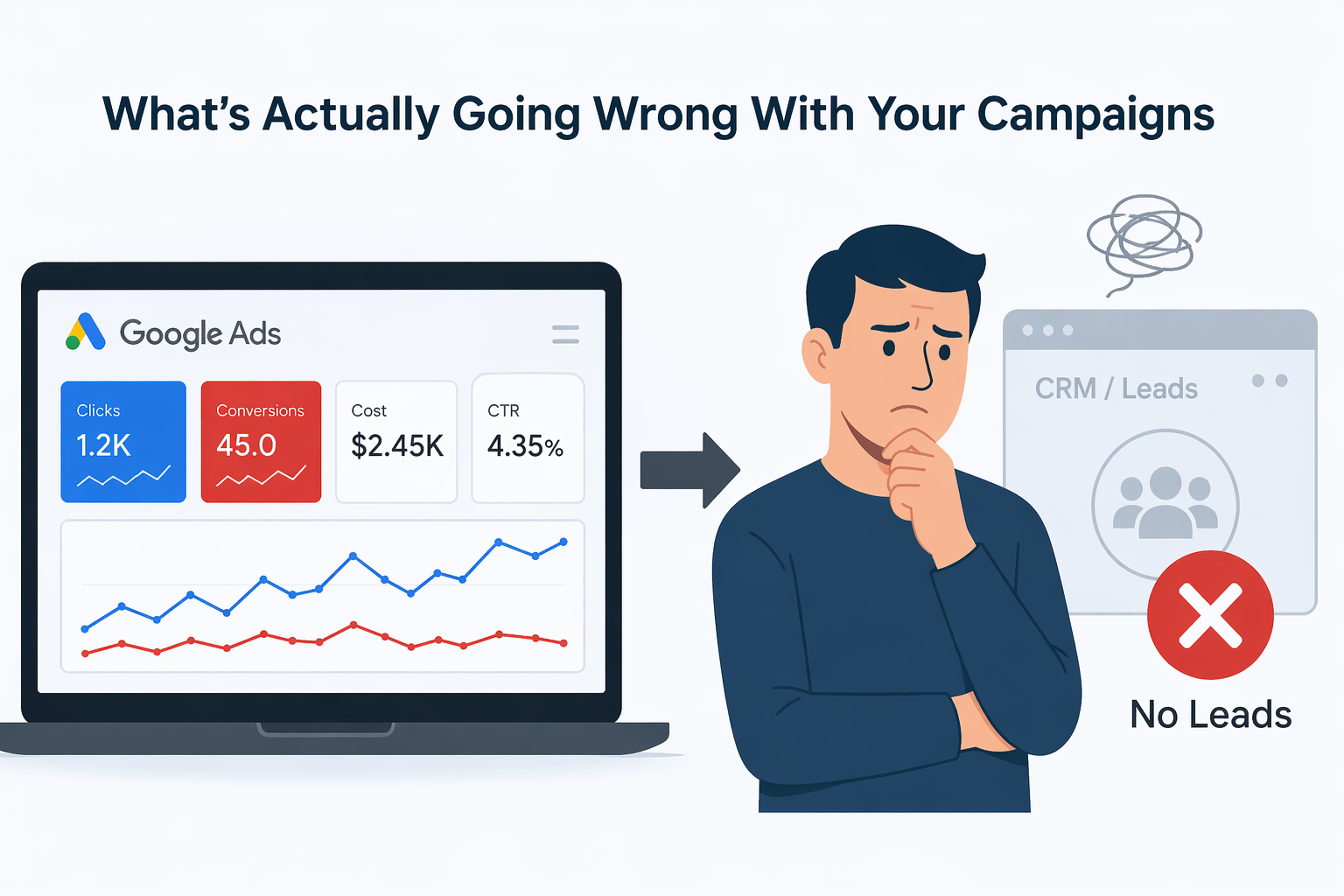
Say you log into Google Ads as a business owner and see a decent number of clicks with a reasonable-looking conversion count. You figure things are fine. But the lead calls are not there. The CRM is not really filling up. And the revenue is not moving the way you would expect based on what you are spending.
You have probably typed something like “Google Ads spending money but no leads” into Google already. Or maybe “high CPC but low conversions Google Ads.” Perhaps you are wondering why your low ROAS Google Ads campaign keeps promising to turn around and just does not. Or why poor lead quality from Google Ads has not improved despite all the tweaking.
Google Ads reporting can suggest that campaigns are active and generating activity, but your business results are what confirm whether the account is truly performing.
That gap, between what the dashboard is showing and what your business is really earning, is where most Google Ads mistakes that waste budget quietly live. The platform is not lying to you. It is measuring whatever it has been asked to measure. If that setup has been wrong from day one, every decision after that adds up to the problem.
What Actually Changed Between 2024 and 2026?
More recently, Google rolled out AI Max for Search, bringing far more automation into campaign management than most advertisers were used to before.
Advertisers now have more automation built into matching, bidding, creative, and landing page expansion than they did just a few years ago.
That shift has changed how campaigns behave, how traffic expands, and how mistakes compound when the account foundation is weak.
Performance Max is no longer the experimental product it once was. Smart Bidding is no longer optional in practical terms either. The platform has shifted a lot, which means the mistakes that were normal in 2023 are expensive now. And the mistakes that are common in 2026 are different from the ones that were showing up even at the end of 2025.
That is exactly what most advertisers have not caught up to yet.
Mistake #1: Trusting Google’s AI Without Questioning It
This is one of the most expensive mistakes on the list.
Google’s AI is genuinely good at certain things. Real-time bid adjustments, pattern recognition at scale, creative testing, and signal processing are tasks no human team could realistically match at the same speed. But here is the part people keep missing: automation follows the signals and objectives it is given, which do not always align perfectly with business profitability.
There is an interesting study from Smarter Ecommerce looking at over 250 retail campaigns that found AI Max delivers conversions at roughly 35 percent lower ROAS compared to traditional targeting in the same account. Why? Because the AI is doing exactly what it was told to do, maximize conversion volume inside the budget. Which often means casting a wider net to queries and audiences that spend more but convert worse.
The Auto-Applied Recommendations Trap
You will find plenty of suggestions in Google’s “Optimization Score” like “increase budget by 40 percent,” “apply broad match,” “enable auto-generated assets,” and “turn on final URL expansion.” If you follow every suggestion, your score climbs closer to 100, which feels like a win.
In practice, that is not always the case.
Paid search consultants doing audits right now keep finding the same thing: accounts that blindly accept recommendations often end up spending more without actually making more. One consultant recently noted that she regularly cuts 20 to 40 percent of wasted spend just by tightening up the things Google’s AI had quietly widened.
What To Actually Do
- Turn off auto-applied recommendations until each one has been reviewed manually
- Treat Google’s suggestions as ideas, not commands
- Measure real profit, not just “conversions” (more on that in a bit)
- Keep a human hand on every big automation decision
Automation is powerful, but without oversight it can scale inefficiency faster than most advertisers expect.
Mistake #2: Using Broad Match Without the Right Setup
Broad match in 2026 is not the same thing as broad match in 2021, and most advertisers have not fully updated the way they think about it.
Search matching has become much broader than many advertisers still assume, and with AI Max layered on top, a single keyword in your account can trigger ads for dozens of searches you never actually targeted, some highly relevant, some completely unrelated to what you sell.
When Broad Match Actually Works
- Conversion tracking is solid, not “kind of working”
- The account is getting at least 50 conversions a month per campaign
- It is paired with Smart Bidding (Target CPA or Target ROAS)
- A real negative keyword list is in place, usually 200 to 500 negatives per account
- Landing pages are genuinely good across the board
Missing any of those and broad matches can waste spend very quickly.
The Small Business Trap
For smaller accounts, it is even harsher. Google Ads broad match mistakes in 2026 hit small businesses hardest because the trade-off is so lopsided. If a broad match works, you get a little extra volume. If it does not, you can lose two or three times what you would have spent on exact or phrase match before you even notice something is off.
Take the example of a coaching business that kept getting inquiries from people searching “free coaching” after broad match was turned on. Once “free” was added as a negative keyword and a proper negative list was built out, the irrelevant clicks largely disappeared within six weeks and their CPA dropped by around 30 percent.
Quick Fix
If a broad match is active in your account right now and you do not have a 200+ negative keyword list, pausing it is worth serious consideration immediately.
Pull your search terms report from the last 30 days and you will usually have more than enough reason to justify that decision within about ten minutes.
Mistake #3: Broken Conversion Tracking (The Quiet Killer)
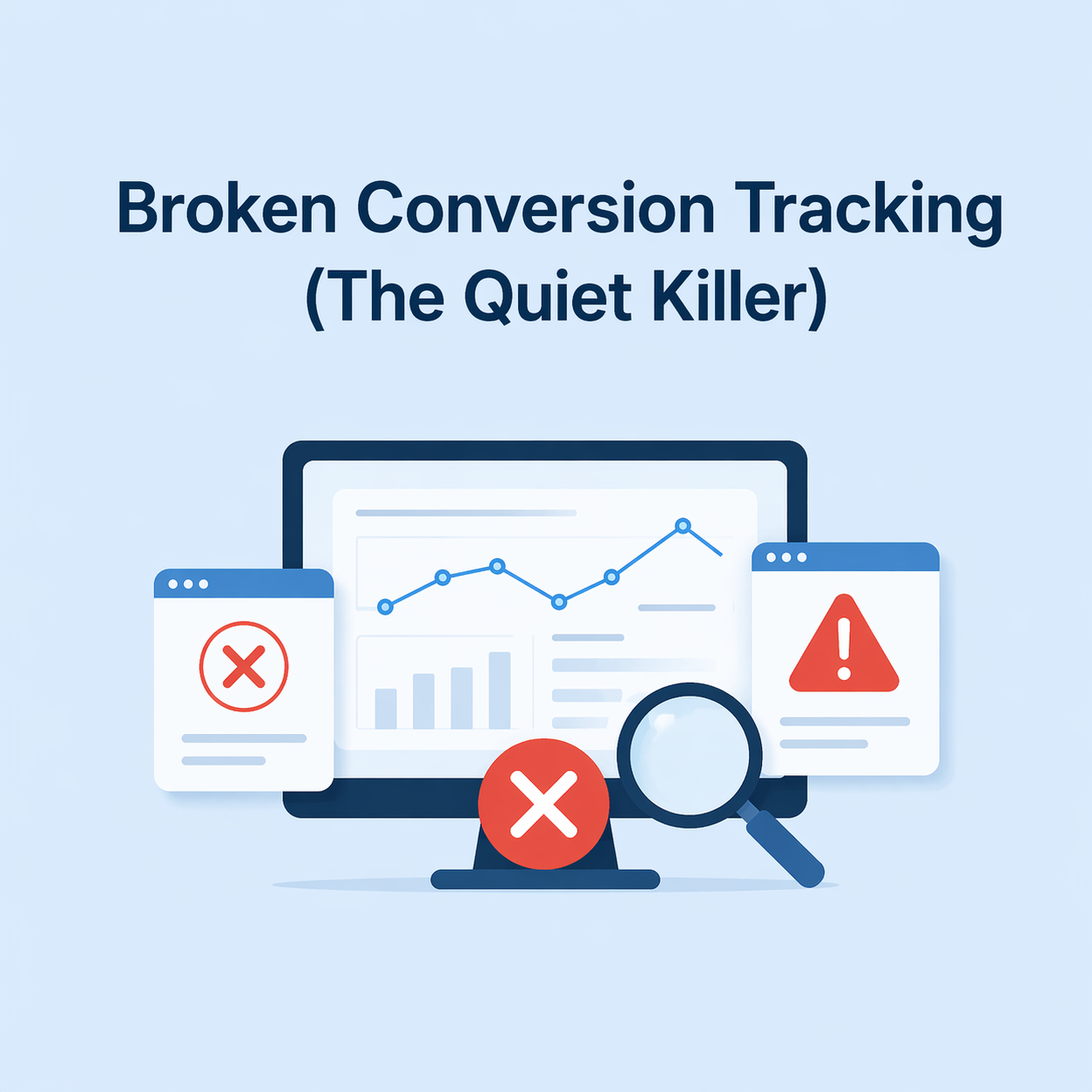
This issue affects everything that comes after it. And almost every account has some version of it going on.
Here is the problem. If conversion tracking is wrong, inconsistent, or counting the wrong actions, then Smart Bidding, Performance Max, and AI Max cannot work the way they are supposed to. You are effectively telling the AI to find more of something, but that “something” is not the right thing.
Common Conversion Tracking Mistakes in 2026
A few patterns show up in almost every audit:
Counting every page view as a conversion.
The account shows a 40 percent conversion rate. The actual lead rate is under 3 percent. Smart Bidding is optimizing for cheap, meaningless actions and rewarding the wrong signal.
Different attribution windows across campaigns.
One campaign uses a 30-day click window, another uses 7-day. The account data becomes difficult to compare, and the AI is making decisions on numbers that do not line up.
Counting every click event as a conversion.
Button clicks, scroll depth, long sessions, all tagged as conversions. Great for vanity. Terrible for optimization.
Not tracking micro-conversions at all.
If only the final conversions or demo requests get counted, Google’s AI is being fed with almost nothing to learn from. The better-performing accounts in 2026 are tracking add-to-cart, form starts, key page visits, and engagement events.
What To Actually Track
Clean conversion setup in 2026 looks roughly like this:
- One primary conversion per campaign, mapped to real business value
- The same attribution window across your account
- Enhanced Conversions turned on so data stays cleaner in a cookieless world
- Offline conversion imports from your CRM if you are doing lead gen
- Separate conversion actions for micro-events so the AI has signal, but only your primary ones count in the “Conversions” column
Without this foundation in place, it becomes very difficult to run Google Ads effectively.
Mistake #4: Landing Pages That Don’t Match the Ad
This is one most people do not even file under “Google Ads mistakes,” but it may be one of the most expensive things on the whole list.
Your ad promises something specific. Someone clicks. The landing page is slow, generic, or not really about what the ad said. They bounce. That poor landing page experience sends weak signals back into the system. Your Quality Score drops. Your CPC goes up. Your impression share shrinks. Smart Bidding gets confused and starts making worse decisions.
One weak landing page can undermine performance across the account.
What a Good Ad-to-Landing-Page Match Actually Looks Like
The fundamentals are straightforward, but many advertisers still get them wrong. Here is what a page that actually works with its ad has going for it:
- The headline picks up where the ad left off. Whatever promise got the click should be the first thing on the page. No bait and switch.
- The CTA matches the one in the ad. If the ad said “Get a free quote,” the page should not suddenly be pushing a whitepaper. Obvious, but surprisingly easy to get wrong.
- Under 2.5 seconds to load on mobile. Any slower and you are losing people before they have even seen what you are selling.
- The content answers what the person actually searched for. Not “generally relevant,” specifically matched to intent. Big difference.
- One clear next step, not a maze of options. A page trying to do five things usually ends up doing none of them well. Pick the one action that matters and make it impossible to miss.
The Real Cost of Weak Landing Pages
Here is why Google Ads landing page mistakes hurting conversions slip past so many teams: the ads themselves look fine. Clicks are coming in. Google’s reporting shows “delivered impressions” and “engaged users” like everything is working. But the conversion rate is quietly telling a different story, and that is usually where the truth lives.
Picture a campaign with one strong landing page and three mediocre ones running alongside it. Google’s AI is smart enough to figure out which page converts better and will start funneling more traffic to the good one. That sounds fine in theory, except the three weaker pages are still consuming budget in the meantime. It gets worse in AI Max campaigns, where Google picks landing pages automatically, a single bad page can pull down the performance of everything else through final URL expansion.
The fix is usually straightforward. Audit your landing pages the same way you audit your ads. If a page would not hold up as a standalone marketing asset on its own, it probably does not belong behind a paid ad either.
Mistake #5: Restarting the Learning Phase Over and Over
This is another mistake even experienced advertisers make.
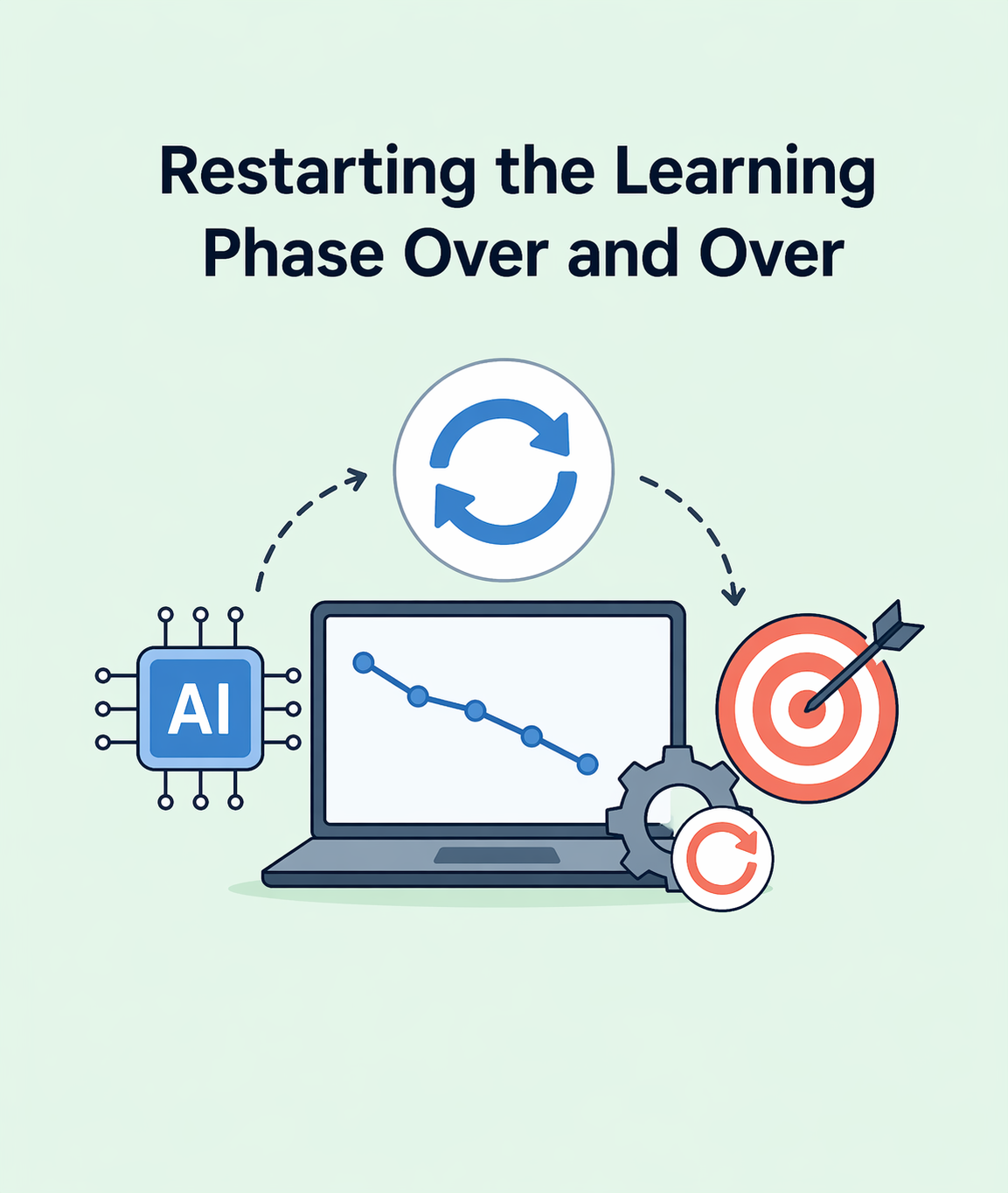
Smart Bidding and AI-powered campaigns need one thing above everything else to work well: stability. Every time a bid strategy gets swapped, a campaign gets paused, a budget shifts more than 15 or 20 percent, or ad groups get restructured, Google’s AI effectively has to start learning again. It is similar to restarting a system every time it begins to stabilize. You are just not going to get very far.
Google’s own guidance says to give a campaign a proper runway and enough conversions before making serious tCPA or tROAS tweaks. In reality, most advertisers cannot even wait a full week before they start poking at things.
Signs You’re Restarting Learning Without Realizing It
A few patterns that quietly reset the learning phase without most teams catching on:
- Budget swings of more than 15 percent in a single day. Even if it feels like a small adjustment, the AI reads it as a major signal change.
- Bid strategy changes more than once a month
- Pausing campaigns over weekends
- Major structural changes mid-campaign (splitting ad groups, changing match types)
- Switching between Target CPA and Target ROAS without letting a full conversion cycle run in between
Every one of these costs you data. And on an AI-first platform, data is critical. Cut off the supply and performance starts to suffer.
The Patience Thing
Once you launch something new or make a real change to a campaign, the best next step is usually to leave it stable for long enough to gather meaningful data. Two to three weeks. Hands off. Let the AI actually collect enough information to understand what it is looking at.
You would not judge the full outcome too early, so do not do that with a brand-new campaign on day three either. The accounts pulling the best numbers right now are not the ones tinkering every morning. They are the ones making the right calls up front and then having the patience to let those calls play out.
A Checklist You Can Actually Run This Week
To catch the most common Google Ads mistakes in your own account before the next billing cycle closes, here is the audit process:
- Turn off auto-applied recommendations. Settings → Account-level settings → Recommendations. Review each one manually before saying yes to any of them.
- Pull your search terms report. Look at the last 30 days. Anything that clearly does not match buyer intent should go into your negative keyword list immediately.
- Audit your conversion tracking. Pick one primary conversion per campaign. Make sure attribution windows match across the account. Remove “conversions” that are not actually conversions.
- Load-test every landing page. Under 2.5 seconds on mobile. The headline matches the ad. CTA is clear. If any page fails, fix it before spending another dollar sending traffic to it.
- Check your geo targeting. Location options → make sure it is set to “People in or regularly in your targeted locations,” not “People interested in.” This one setting alone saves some accounts 20 percent or more.
- Review learning phase status. Any campaign that has been stuck in “learning” for more than 14 days is usually being destabilized by constant changes. Leave it stable long enough for the system to recalibrate.
- Look at Quality Score on your top 20 keywords. Anything below a 7 deserves attention. Pushing a keyword from a Quality Score of 4 up to 8 can significantly reduce CPC, which is a big gain for something that costs nothing but effort to fix.
Also worth checking, are you actually running on AI Max? Some accounts may be using AI Max or similar automation without a full review of the account foundation. If yes, make sure you actually have the basics in place first: 100+ monthly conversions, a real negative keyword list, and some proof that broad match has worked for you before. If any of those are missing, turn AI Max off for now. You can always come back to it once the foundation is there.
A Few Myths Worth Clearing Up
A handful of ideas keep tripping people up, so it is worth putting them to bed properly.
Myth: Bigger budget means better performance.
Not really. Throwing more money at a broken campaign usually accelerates inefficient spend. If the setup is wrong, a $10,000 monthly spend will not magically fix what $2,000 could not. Patch the leak first, then turn the tap up.
Fix the leak before the tap gets turned up.
Myth: Broad match + Smart Bidding = set and forget.
Only if the data foundation is clean. Otherwise you are feeding the system poor-quality signals and expecting strong outcomes.
Myth: Ad strength impacts Quality Score.
Not directly. Research from Adalysis has found that lower ad strength ads can still have higher conversion rates because you are keeping control of the messaging. Ad strength should not be treated as the only quality signal, but it should not be dismissed entirely either.
Myth: AI Max works for every account.
It does not. Accounts with thin negative lists, weak landing pages, or fewer than 100 monthly conversions usually see worse results with AI Max, not better.
Myth: You should check and tweak daily.
Smart Bidding needs at least 14 days of stable data to learn anything useful. Daily tweaking is one of the fastest ways to keep a campaign stuck in permanent learning mode.
When You Actually Need to Do Something About This
If any of these sound familiar, this needs attention now, not next quarter:
- Your CPC has crept up 15 percent or more in the last 90 days with no clear reason
- Spend is consistent but lead quality keeps slipping
- Your low ROAS Google Ads campaign has not improved in the last 60+ days, even with tweaking
- Conversion count looks fine on paper but your revenue is not matching
- You have been following Google’s recommendations and profit has actually gone down
Every week you wait, the AI keeps training on bad data, and the cost of fixing it later gets higher. CPCs have been climbing roughly 10 to 15 percent year over year across most industries since 2023. The accounts that sit on this end up paying more for clicks that work less. That is not sustainable for any business.
Where a Good Google Ads Team Actually Makes a Difference
Most in-house marketing teams were built for what Google Ads used to be. The skills required to manage Google Ads well have changed significantly. Today’s tasks include configuring AI systems, cleaning up data pipelines, managing automation guardrails, and knowing when automation needs human intervention.
Good Google Ads management services in 2026 tend to focus on the things in-house teams usually miss: proper Enhanced Conversions setup, server-side tracking for data accuracy, monthly Google Ads audit services to catch configuration drift, and a repeatable process for actually testing AI Max and PMax without handing over total control.
If you are weighing whether to hire a Google Ads expert or build it up internally, in many cases the business case increasingly supports experienced specialist support in 2026. Not because internal teams cannot do it, but because the learning curve for doing it well is longer than most businesses can afford while the budget continues leaking in the background.
FAQs
1.Why is my Google Ads campaign not converting?
In most cases, it comes down to one of three issues. Your conversion tracking is broken somewhere, so the AI is optimizing for actions that do not actually matter. Or the landing page does not live up to what the ad promised, so people click, do not find the expected experience, and leave. Or you have broad match running without a real negative keyword list behind it, which means a chunk of your budget is paying for clicks that were never going to turn into anything.
Fix those three and the conversion problem usually becomes much easier to solve.
2.What are the most common Google Ads mistakes?
If you had asked in 2022, the answer would have looked different. But heading into 2026, these are the five that keep cropping up: following whatever Google’s AI suggests without pushing back on it, running broad match without the setup underneath to control where it goes, conversion tracking that is broken or measuring the wrong things, landing pages that do not really connect back to what the ad said, and changing so much so often that Smart Bidding never gets to finish learning.
3.Should I use broad match in Google Ads?
Only if the account has solid conversion tracking, 50+ conversions a month per campaign, Smart Bidding running, a real negative keyword list (200+), and decent landing pages. Missing any of those and broad match can waste money faster than an exact match could ever save you.
4.How important is conversion tracking in Google Ads?
It is one of the most important parts of the account. If tracking is wrong, every bid decision, every AI optimization, and every automated recommendation is built on bad data. Fix tracking before touching anything else.
5.What is AI Max in Google Ads?
AI Max is one of Google’s newer AI-led Search capabilities and introduces much more automation into campaign management. It can work well for mature accounts with good conversion data. It can also be risky for accounts without that foundation.
6.How can I fix poor Google Ads performance quickly?
Start with a proper audit. Check conversion tracking, go through the last 30 days of search terms, add aggressive negatives, pause anything that is underperforming, check geo targeting, and review landing page match. Most accounts see measurable improvement just from fixing those basics within about 30 days.
What to Do Next
If your campaigns have been spending consistently without delivering the business results you expect, book a free Google Ads audit with our team. We will go through the account, flag the specific mistakes costing money, and hand over a plan to fix them.
If you are not ready for a call yet, grab our free Google Ads Audit Checklist. It is the same process our team uses when opening a new client account for the first time.
Helpful Reads on This Site
Top AI Tools Business Owners Should Know About for Digital Marketing in 2026
The Future of Search: How Voice Search Is Changing SEO in 2026 – The New Normal
AI Overview Ranking in 2026: Improve Google AI Visibility
Wrapping This Up
Google Ads in 2026 is not really about beating the algorithm. It is about not feeding it bad inputs.
Are the accounts doing the best right now? Not the ones throwing the most money at it. Not the ones running some elaborate multi-layered strategy either. It is the ones with clean conversion tracking, a proper list of negative keywords, landing pages that actually follow through on what the ad said, and the patience to stop interfering with Smart Bidding while it is still trying to figure things out.
That is the core difference between efficient accounts and wasteful ones.
Google’s AI really is impressive when you see it work. No argument there. But it can only ever be as smart as whatever you hand it. When the inputs are weak, automation tends to scale the underlying problem. Give it something clean to work with and it can do things your team could never match manually, no matter how many hours they put in.
When the setup is broken, automation usually amplifies the weakness. When the setup is clean, it can create efficiency that manual management alone often cannot.
The real skill in 2026 is not just running Google Ads. It is knowing what to let the AI do, and what to never let it near.
The teams that figure out that distinction are the ones whose ad budgets actually turn into revenue. Teams that do not make that distinction often end up questioning why spend increased without meaningful business growth.
If you want a shortcut to getting this right, our Google Ads experts can help. Book a free audit and you will see exactly where the budget is leaking, and how to plug it.
About PPCROY
PPCROY is a results-driven digital marketing and growth agency focused on helping businesses generate more qualified leads, improve conversions, and scale revenue through strategic online marketing. The team provides expert support across services such as SEO, Google Ads, Meta Ads, funnel optimization, landing page strategy, and performance-focused digital campaigns. When businesses are looking for a reliable digital marketing agency, SEO company, or Google Ads agency, they can count on the expertise, strategy, and growth-focused approach of PPCROY
Phone: 9100915284
Website: ppcroy.com