
Summary
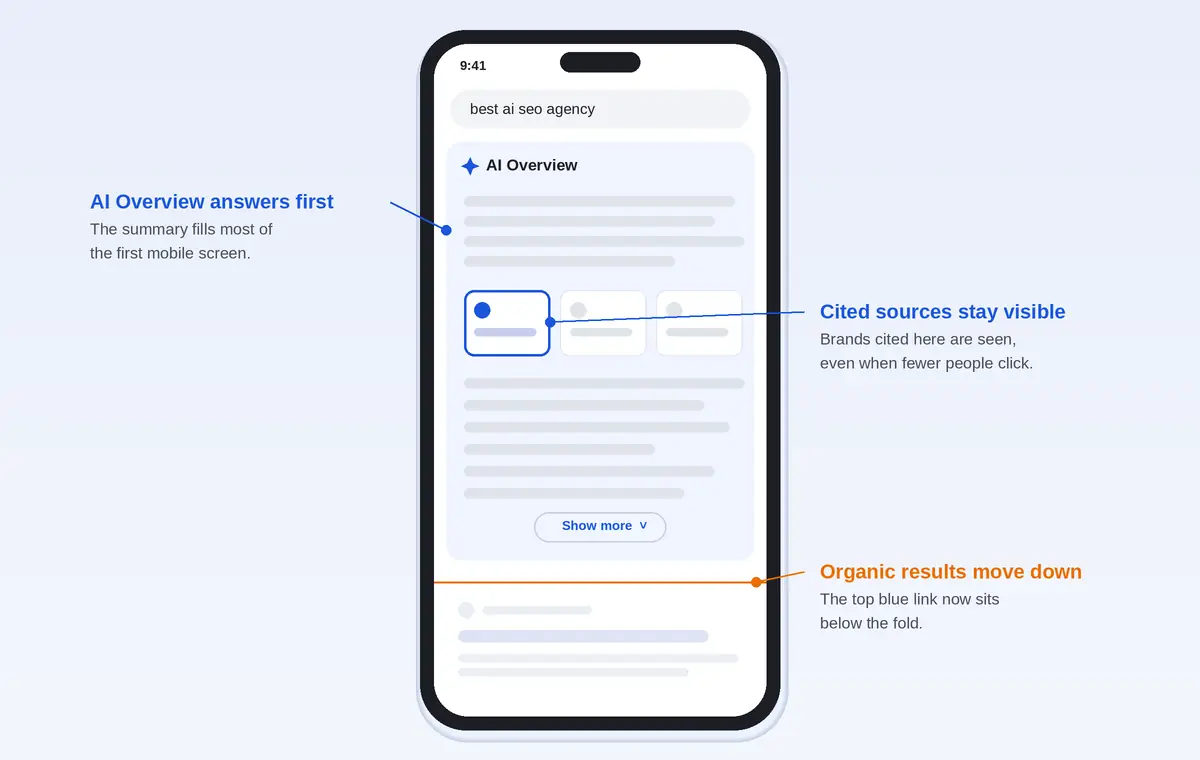
Only 8 percent of people click a search result when an AI Overview appears. Take the summary away, and that number nearly doubles. If your traffic has been slipping and nobody on your team can explain it, this is probably why. Here’s what’s actually working in AI Overviews SEO right now, and how to improve your chances of getting cited again before your competitors pull ahead.
Introduction
Let’s start with a number that stood out the moment I saw it.
Back in July last year, Pew Research ran a study to understand what people actually do when an AI summary appears at the top of their search results. Only 8 percent clicked through to a real website.
Now compare that to what happens when the AI summary is not there. That number nearly doubles. Think about what that means for anyone who has spent the last ten years building traffic through Google.
If your traffic has been falling lately without an obvious reason, this may be why. Rankings still look fine. Impressions are steady. But the clicks are no longer coming in the way they used to.
That is what AI Overviews SEO is really about now. While businesses are still trying to stay visible, Google’s own AI is already answering questions before users ever reach a website.
AI Overviews now appear across a growing share of searches, and their presence continues to expand across more industries. That makes AI Overview visibility a real SEO priority in 2026. So yes, AI Overview ranking in 2026 is something every business has to deal with, whether the team is ready or not. This guide shows you how to rank in Google AI Overviews and what Google AI Overview SEO looks like right now.
Let’s get into what is actually working.
The Quick Version, If You’re Short on Time
AI Overviews SEO is basically the process of structuring your content so Google’s Gemini model is more likely to cite it when generating an AI summary.
You need to:
- Answer questions quickly
- Show strong trust signals
- Use proper schema
- Include images and video
- Build topic clusters instead of publishing isolated blog posts
Traditional SEO still matters, but it no longer does the full job on its own.
What’s Really Going Wrong With Your Traffic
Short answer: If rankings are stable but clicks and leads are falling, AI Overviews are likely answering the query on the results page and citing other sources instead of yours.
When we speak with marketing teams facing this issue, the pattern is usually the same. Their rankings have not dropped much. They still appear on page one for their target keywords. But form fills are down. Calls are lower. Demos have slowed. Something feels off, and nobody can clearly point to the reason.
You have probably searched something like “why my site is not showing in AI Overviews” already. Or maybe “content not appearing in Google AI results” even though the page ranks well. Many sites are now stuck in a strange middle ground: indexed, ranking, but not visible in AI search.
Google knows the page exists. It just does not trust it enough to quote it.
And when your website is not cited in AI Overviews while a competitor appears twice in the same answer box, that is not a penalty. It is a structural shift. Google’s AI is using a new set of signals to decide which sources are worth pulling from. If your content has not caught up to those signals, you become invisible.
So What Is Google AI Overview, Actually?
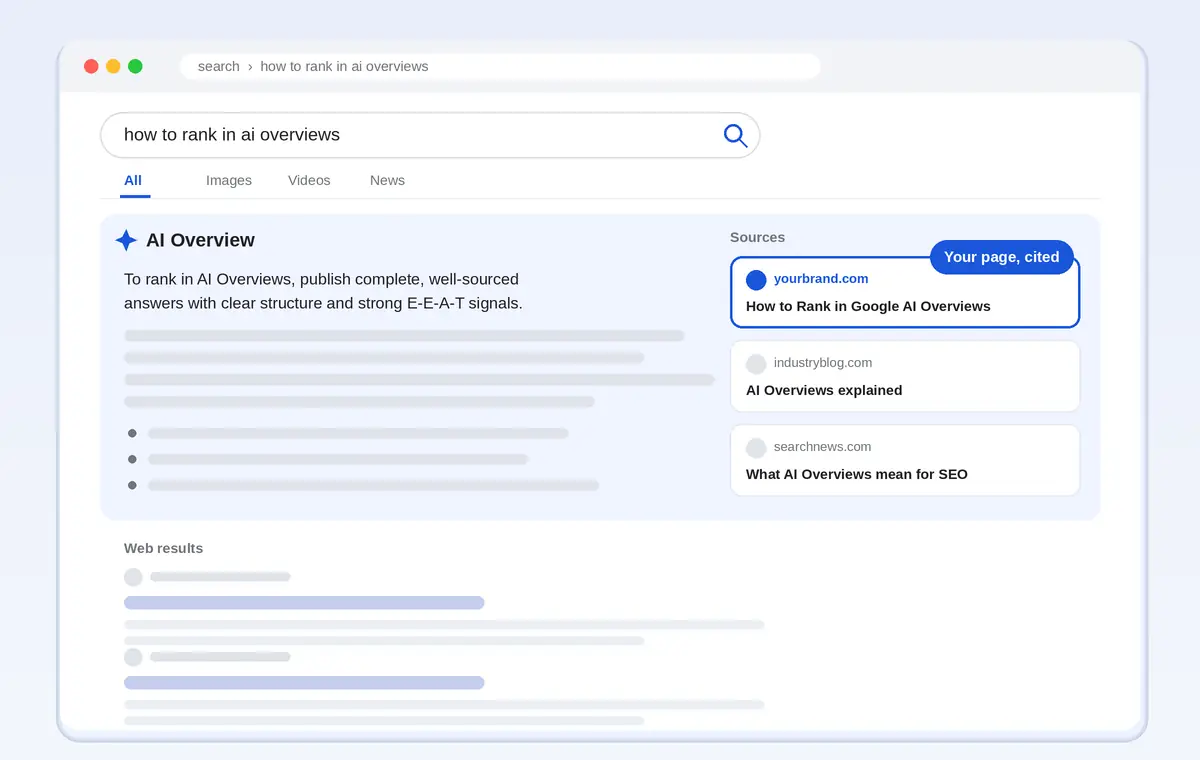
In simple terms, it is the AI-generated summary that now appears above the regular search results for many queries. Google reads multiple web sources, combines the most relevant information using its Gemini model, and presents one answer with supporting links underneath.
Google officially launched AI Overviews in May 2024 at its I/O event. Before that, the feature was known as Search Generative Experience (SGE). The experience has continued to evolve since launch, with ongoing model improvements and product updates that expanded AI Overviews and introduced AI Mode.
Changes in Google’s AI systems and search experience have likely affected how sources are selected and cited over time. If your clicks dropped while rankings stayed stable, this may be one of the reasons.
There is also AI Mode, which is the more conversational version of this experience. Users can ask follow-up questions and continue interacting with Google’s AI. Winning at Google AI Overview SEO now means showing up in both places, so Google AI Mode SEO deserves the same attention.
Why This Matters More Than You Think
Short answer: AI Overviews reduce clicks to regular results, but pages that get cited earn more qualified visibility, so being the source Google quotes now matters as much as ranking.
Here is the honest version. The news is mixed.
- SparkToro’s research puts zero-click searches at around 58 percent now (its 2026 update with Similarweb puts U.S. zero-click searches even higher, at around 68%)
- Gartner has projected a 25 percent drop in organic traffic by the end of this year
- Nieman Lab at Harvard has written extensively about how publishers are getting squeezed
None of that is encouraging if your business depends on website visits.
But here is the part fewer people talk about.
If your page gets cited inside an AI Overview, it can attract more qualified visibility than a page that is not cited. The users who click through from cited answers are often further along in their decision-making process, which can make that traffic more valuable.
The equation has changed. Google AI results visibility is no longer just about ranking high. It is about becoming the source Google chooses to trust.
How Do AI Overviews Actually Work Under the Hood?
Short answer: Google splits each search into related sub-questions (query fan-out), finds pages for each one, and Gemini combines the best passages into one summary with cited links. A page that answers a sub-question clearly can be cited even if it does not rank first.
This part matters, because it changes how you should think about content.
Google uses something called query fan-out. That means a search is not processed as one single question. Instead, it gets broken into several related sub-questions that run at the same time. Gemini then pulls citations from across that wider result set.
That is why you will sometimes see a page ranked sixth, or even lower, appear as a source. It probably answered one of those supporting sub-questions better than the pages above it.
Here are some numbers that should shape how you think about ranking in Google AI results in 2026:
| Stat | What It Means |
| Only 17% of sources cited in AIOs rank in the organic top 10 (BrightEdge) | Ranking first is no longer enough |
| 47% of citations come from pages ranking below position 5 | Lower-ranking pages can still win |
| 18%+ of outside-top-100 citations come from YouTube alone (Ahrefs, Dec 2025) | Video is now a major citation driver |
| 88% of AI Overviews cite 3 or more sources | Most answers are built from multiple pages |
| Longer AIOs can pull from up to 28 pages | Depth and coverage matter |
| 6.49% → 13.14% rise in AIO query coverage (Jan to Mar 2025, Semrush) | This is evolving very quickly |
AI search optimization has now become its own discipline. A lot of people are calling it generative engine optimization (GEO) or answer engine optimization (AEO).
Traditional SEO vs AI Overviews SEO vs GEO vs AEO
| Aspect | Traditional SEO | AI Overviews SEO | GEO | AEO |
| Main goal | Rank pages in the regular search results | Get cited inside Google’s AI Overviews and AI Mode | Get cited in AI answers across ChatGPT, Gemini, Perplexity, and Google | Be the direct answer to a specific question |
| Where you show up | Organic blue links | The AI summary at the top of Google | Answers inside AI chat and search tools | Featured snippets, voice answers, and AI answers |
| How success is measured | Rankings, clicks, and traffic | Citations and share of voice in AI Overviews | Brand mentions and citation frequency across AI platforms | Answer placements and question coverage |
| Content focus | Keywords, backlinks, and technical health | Answer-first sections, schema, E-E-A-T, and topic clusters | Entity clarity, sourced facts, and third-party mentions | Question-based headings with short, direct answers |
AI Overview Ranking Factors: The Signals That Actually Drive Citation
Short answer: The strongest AI Overview ranking factors are complete, self-contained answers, multimodal content, strong E-E-A-T, clear entities, accurate schema, fresh content, and fast-loading pages.
Based on third-party studies of AI Overview citations, a few consistent patterns have started to emerge. Here is what matters most and why.
1. Semantic Completeness Comes First
Pages that answer a question fully in a self-contained block of around 134 to 167 words are about four times more likely to get cited. The takeaway is simple: lead with the answer and save the background for later.
2. Multimodal Content Is the Second Big One
Pages that combine text with images, short video, and structured data can see selection rates up to 317 percent higher than plain-text pages. YouTube becoming one of the top-cited sources is not random. Google’s AI is looking for content that supports the full experience, not just written explanation.
3. E-E-A-T Has Quietly Shifted From a Guideline to a Filter
Around 96 percent of AI Overview citations come from sources with strong expertise and trust signals. Google’s Search Quality Rater Guidelines reward firsthand experience, named expertise, and real authority. This used to be a bonus. Now it is basic entry-level credibility.
4. Entity Density Matters More Than Most SEOs Realize
Pages that mention 15 or more recognized entities per thousand words, such as people, places, companies, and concepts, see around 4.8 times higher selection rates. Google’s Knowledge Graph is essentially checking whether your page sounds like a real source with a clear topical identity.
5. Schema Markup Still Helps. A Lot.
Pages with proper structured data are cited about three times more often. FAQPage, HowTo, Article, and Organization schema are the formats that tend to make the biggest impact.
6. Freshness Has Become Surprisingly Important
About 53 percent of AI Overview citations come from content updated within the past six months.Simply changing the publish date without meaningfully improving the content is not a reliable strategy. Content updates should reflect real improvements, not cosmetic freshness.
7. Page Speed Is the Surprising One
Pages with a First Contentful Paint under 0.4 seconds average 6.7 citations, while pages slower than 1.13 seconds drop to 2.1. That alone tells you how closely performance is tied to visibility.
A Step-by-Step Checklist You Can Actually Use
If you want a practical checklist for improving visibility in Google AI Overviews this week, here is what it looks like:
-
Audit your top 20 to 30 queries
Search them manually and note which ones trigger an AI Overview and which domains are being cited. If you are doing this at scale, tools like Semrush’s AI Overviews Visibility Checker can speed up the process.
-
Review the competitors getting cited
Pick five competitor pages that are being cited for topics you care about. Compare their first 300 words with yours. In most cases, the pattern becomes obvious quickly: their pages answer the question directly, while yours spend too much time setting context.
-
Rewrite sections around answer capsules
Every H2 should begin with a 40 to 60 word answer that can stand on its own and be quoted as a citation without needing extra explanation.
-
Build topic clusters
Because of query fan-out, one page is rarely enough. You need a pillar page supported by related articles that answer the surrounding sub-questions, all properly interlinked.
-
Add real multimodal assets
Use original images, charts, and a short 60 to 90 second video with a transcript when the topic fits. Generic stock visuals are no longer enough.
-
Strengthen your trust signals
Add real author bios, actual credentials, LinkedIn links, firsthand examples, case studies, testimonials, and citations from reputable sources.
-
Get your schema right
Make sure your structured data accurately reflects what is visible on the page. Mismatched schema does not help.
-
Track the right metrics
Focus on AI visibility metrics such as citation frequency, share of voice, attribution quality, and sentiment. Rankings and sessions alone no longer tell the full story.
Common Mistakes and Myths Worth Clearing Up
A few things still slow teams down that really should not.
Myth: If you rank first, you will automatically get cited
That is no longer true under Gemini 3. The overlap between top-10 rankings and AI Overview citations sits somewhere between 17 and 33 percent, depending on the study.
Myth: Longer content is always better
A tightly written 1,200-word article that answers the question well will often outperform an inflated 3,000-word article that drifts.
Myth: AI-written content ranking at the top is safe
Publishing large volumes of AI-generated content without real editorial oversight is risky. Google’s spam policies explicitly address scaled content abuse, regardless of how the content is produced.
Myth: You can just update the publish date
Do not change the publish date unless the content has genuinely been updated. Google has become much better at spotting fake freshness.
When to Actually Do Something About This
If your business depends on informational search traffic this quarter, the time to act is now, not next year.
The industries seeing the biggest impact right now are the ones where AI Overviews already appear for 70 percent or more of relevant queries. That includes healthcare, education, B2B tech, and even restaurants. In those sectors, the gap between cited and uncited sites is widening fast.
Red Flags That Say It’s Time to Move
- Your click-through rate is dropping while rankings remain steady
- Competitors keep showing up in AI Overviews for queries where your brand is missing
- Traffic looks stable in reports, but lead volume is clearly down
And honestly, if you do nothing, your competitors are slowly training Google’s AI to treat them as the default answer in your space. The longer that happens, the harder it becomes to reverse.
How an AI SEO Agency Can Actually Help
Most in-house marketing teams were built for the old SEO model: rankings, keywords, and backlinks. AI Overview SEO services require a broader skill set, including content restructuring for extraction, entity optimization, schema implementation, multimodal production, and ongoing citation tracking.
Strong AI search optimization services combine AI visibility strategy with traditional SEO so both forms of visibility improve together. Many businesses now look for this under names like generative engine optimization services, answer engine optimization services (AEO services), or simply AI SEO services. If you do not have that expertise in-house, partnering with an AI SEO agency or a specialist GEO agency is often faster and more cost-effective than building it from scratch.
The AI SEO companies worth working with will show you actual citation data, not just rankings on a dashboard, and they will have a repeatable process for auditing, rewriting, and tracking across AI Overviews, AI Mode, ChatGPT, and Perplexity.
FAQs
1. What is Google AI Overview?
It is the AI-generated summary you may see at the top of some Google searches. Google uses advanced AI models to generate these summaries and link users to supporting web sources.
2. How do AI Overviews work in Google Search?
Google uses a query fan-out process. A user’s search is broken into related sub-queries, those run in parallel, and citations are pulled from across the result set before the summary is generated.
3. How to appear in AI Overviews?
Start with answer-first writing. Get to the point in the opening lines instead of building slowly toward it. Each section should stand on its own and provide a complete answer without making the reader jump elsewhere. Along with that, you need strong E-E-A-T signals, proper schema markup, a mix of content formats like images and video, and a connected cluster of relevant pages rather than one standalone article. The page should also rank in the top 20 for the target topic and load quickly. Both matter more than many people think.
4. Does schema help with AI Overviews?
Yes. Pages with proper structured data are around three times more likely to get cited. FAQPage, HowTo, Article, and Organization schema tend to work best.
5. Does Google Search Console show AI Overview traffic?
Not directly. Google Search Console does not currently separate impressions, clicks, or positions specifically for AI Overviews. You usually need to track citations manually or use a third-party AI visibility tool.
6. How to get cited in Google AI Overviews?
Improve semantic completeness, add multimodal content, build stronger entity signals through consistent brand mentions, implement proper schema, and genuinely refresh your content. Citations happen when clarity, trust, and structure work together.
7. Why is my site not showing in AI Overviews?
Usually because Google does not yet trust the page enough to quote it. Common causes are answers buried deep in the page, weak E-E-A-T signals, missing or mismatched schema, thin topic coverage, and slow load times. Fix those first, then track whether your pages start getting cited.
8. How long does it take to appear in AI Overviews?
There is no fixed timeline. After meaningful updates, pages are often recrawled within days, but earning consistent citations usually takes several weeks to a few months, depending on your site’s authority, the competition, and how well the page answers the query.
9. Do backlinks matter for AI Overviews?
Yes, indirectly. AI Overviews draw on pages Google already trusts, and quality backlinks remain one of the signals behind that trust. Links alone will not earn a citation, though. Clear answers, structure, and real expertise still matter more.
What to Do Next
If your site is losing visibility to AI Overviews and you are not sure where to begin, book a free AI Overviews SEO audit with our AI search optimization agency. We will show you which queries you are losing citation visibility on and what to fix first.
Not ready to book a call yet? Send us a quick message and we will share the same AI Overview optimization framework our specialists use when auditing client sites.
Helpful Reads on This Site
Top AI Tools Business Owners Should Know About for Digital Marketing in 2026
The Future of Search: How Voice Search Is Changing SEO in 2026 – The New Normal
Zero-Click SEO in 2026: How to Stay Visible When Users Don’t Click Your Website
AI Search Optimization: How Brands Can Rank in ChatGPT, Gemini, and Google AI
Wrapping This Up
AI Overviews SEO in 2026 is not a clean break from traditional SEO. It is more like an extension of it.
The brands doing well right now did not throw away the basics. They kept the fundamentals in place, such as technical health, backlinks, and real authority, and then layered new habits on top. They write in a way that is easy to extract, invest in original visuals and video, go deeper on topics instead of skimming the surface, and show expertise in ways that hold up whether a person is reading or an algorithm is scanning.
But the biggest shift is really a mindset change.
You are not just optimizing to rank anymore. You are optimizing to be quoted.
And the teams making that shift now are the ones whose content will shape how the next generation of searchers understands their industry.
If you want a faster path to getting this right, our AI SEO agency can help. Book a free AI visibility audit and we will show you exactly how to improve your visibility in Google AI Overviews for the queries that actually matter to your business.
About PPCROY
PPCROY is a results-driven digital marketing and growth agency focused on helping businesses generate more qualified leads, improve conversions, and scale revenue through strategic online marketing. The team provides expert support across services such as SEO, Google Ads, Meta Ads, funnel optimization, landing page strategy, and performance-focused digital campaigns. When businesses are looking for a reliable digital marketing agency, SEO company, or Google Ads agency, they can count on the expertise, strategy, and growth-focused approach of PPCROY
Phone: +91 9100915284
Website: ppcroy.com