
Your budget drains a little more every day. The clicks roll in, the dashboard looks busy, and yet your sales team has nothing real to chase. If that is your Monday, you are not imagining it, and you are not alone.
The problem most advertisers feel but cannot name
The average advertiser now pays around $66 to $70 for a single Google Ads lead, according to WordStream’s latest benchmark data. And in legal services, that figure climbs past $130 per lead.
So when Google Ads spending money but no leads becomes your reality, the cost of getting it wrong is brutal. Every wasted click is real money gone.
Here is the uncomfortable truth. Google Ads not getting quality leads is rarely a Google problem, and it is almost always a strategy problem hiding in plain sight.
This guide walks through exactly why Google Ads not converting happens, plus how to fix it in 2026 without simply throwing more budget at the wall.
The Quick Answer
When Google Ads not getting quality leads is the pattern, the cause usually sits in one of five places. Targeting, keywords, landing pages, tracking, or the offer itself.
The clicks are fine. What happens between the click and the conversion is where the money leaks out. So fixing the leak matters far more than buying more clicks.
Sort out two or three of these, and most accounts see better lead quality and a lower cost per lead within 30 to 60 days.
When the Clicks Come but the Leads Do Not
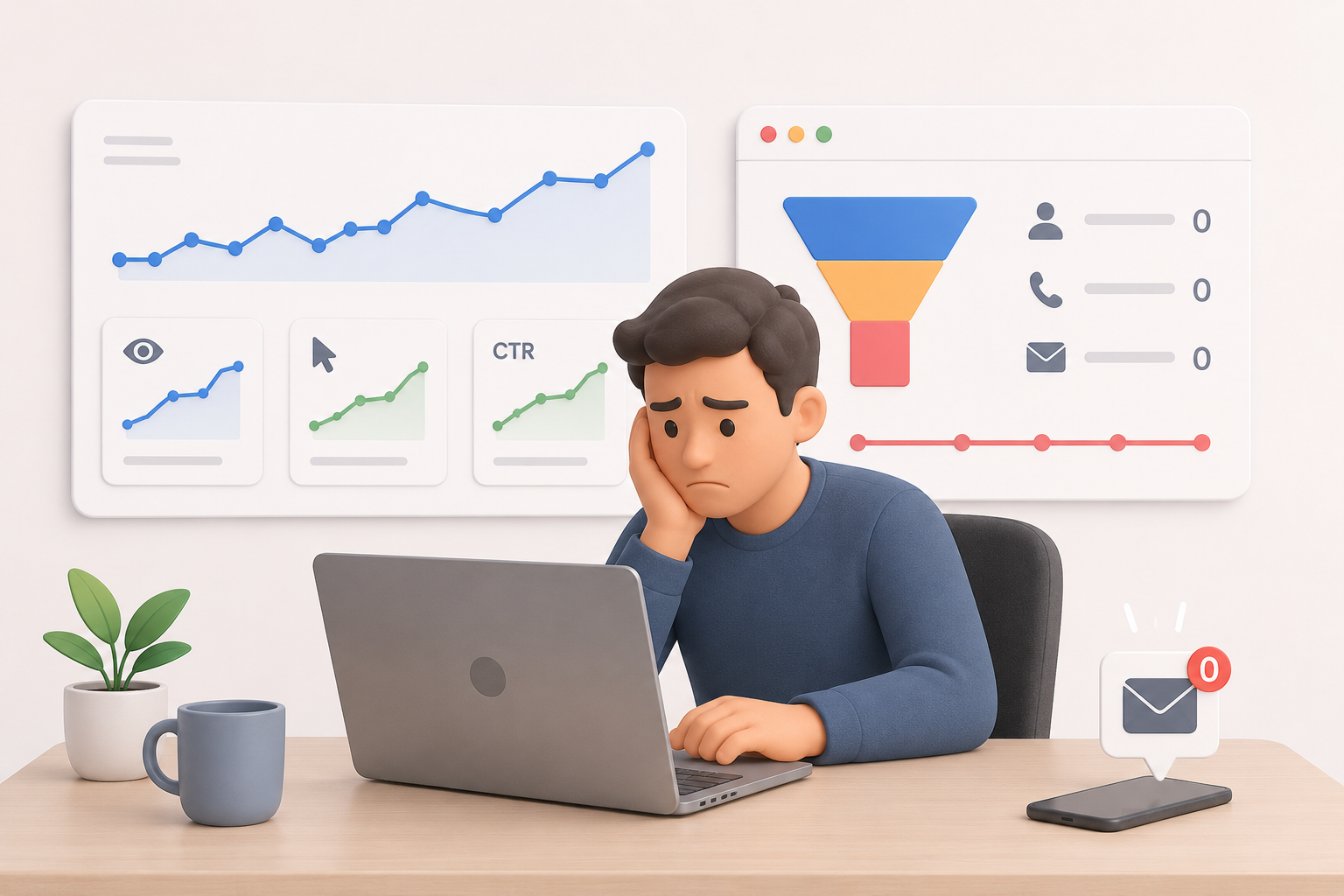
Picture a business owner watching the dashboard light up. Impressions climbing, clicks ticking over, the CTR graph pointing in a nice direction.
And then the phone stays silent. The inbox stays empty. That gap between activity and outcome is the whole frustration in a single image.
If you have searched “why am I getting clicks but no leads from Google Ads,” you have lived this. The numbers look like progress, but they do not pay the bills.
The hard part is that surface metrics can flatter you for months. Meanwhile your budget quietly funds visitors who were never going to buy.
Clicks are not the product. Leads that close are the product. Everything else is just expensive noise.
What Does “Poor Lead Quality” Actually Mean?
Google Ads poor lead quality means the form fills and calls are arriving, but they are the wrong people. Tyre-kickers, job seekers, competitors, and accidental clicks.
So you are technically converting, yet none of it turns into revenue. That is arguably worse than zero leads, because it feels like progress while wasting your sales team’s time.
Most Google Ads low quality leads trace back to one root cause. Your targeting and keywords are pulling in browsers when you need buyers.
In plain terms, the account is optimised to generate activity, not customers. And those are very different goals.
Why This Matters More Than Ever in 2026
Costs are not standing still. WordStream found the average cost per click rose nearly 13% year over year, so every wasted click stings more than it used to.
And the spread between winners and losers is enormous. The average Google Ads conversion rate sits around 7.5%, yet top-quartile accounts often beat that by 50% or more.
That gap is rarely about budget. It is about structure, intent, and what happens after the click.
So Google Ads wasting budget is not a fixed cost of doing business. It is a solvable problem, and the businesses that solve it pull clearly ahead.
The Real Reasons Your Google Ads Are Not Converting
Here they are, roughly in the order they tend to do the most damage.
1. You Are Bidding on Browsers, Not Buyers
This is the silent killer behind most Google Ads lead generation problems. Someone searching “what is a CRM” is curious, while someone searching “buy CRM for small business” is ready.
And if your keywords skew toward the first type, you pay to educate people who will never buy. Intent is everything in paid search.
The fix: Audit your search terms report and sort by which queries actually convert. Then double down on buyer-intent keywords and pause the browsers.
2. Your Match Types Are Too Loose
Broad match feels efficient, but left unchecked it sprays your budget across loosely related searches. That is a fast route to Google Ads high cost per lead.
And without guardrails, Google will happily spend on terms you would never choose yourself. The platform optimises for clicks, not for your bank balance.
The fix: Tighten your keyword match types and build a serious negative keywords list. Block “free,” “jobs,” “cheap,” and anything that signals the wrong intent.
3. Your Landing Page Is Doing the Leaking
You can win the click and still lose the lead right here. A slow, cluttered page, or worse, sending paid traffic to your homepage, quietly kills conversions.
And the homepage is the classic mistake. It has ten things to do and no single clear action, so the visitor does none of them.
The fix: Build a dedicated landing page for each campaign with one offer and one call to action. A focused page can lift your landing page conversion rate dramatically.
4. Your Tracking Is Lying to You
If your conversion tracking setup is broken or half-configured, every decision after that is a guess. And guesswork in paid search is expensive guesswork.
You cannot tell which keywords drive real leads, so you optimise toward the wrong things. The account drifts further off course with every “improvement.”
The fix: Set up clean conversion tracking in GA4 for every meaningful action. Form fills, calls, and chats all need to be measured before you spend another rupee or dollar.
5. Your Quality Score Is Quietly Taxing You
Low quality score means you pay more for worse positions. It is Google’s way of charging you extra for ads that do not match what people want.
And it compounds. Poor ad relevance raises costs, which shrinks results, which makes everything look broken.
The fix: Align your keyword, ad copy, and landing page around the same intent. Tight ad relevance lifts Quality Score, and a better score lowers your cost per click.
Most accounts do not have a traffic problem. They have an “everything after the click” problem.
Your Google Ads Lead Quality Checklist
Two weeks of focused work, in this order. No budget increase required.

Step 1: Mine your search terms report. Find the queries eating budget without converting, and add them as negatives this week.
Step 2: Tighten targeting. Move loose broad-match keywords to phrase or exact, and layer in audience signals.
Step 3: Build one real landing page. Pick your top campaign and give it a dedicated page with a single clear offer.
Step 4: Fix tracking first. Confirm GA4 and conversion tracking fire correctly for every lead action before optimising anything else.
Step 5: Rewrite your CTA. Swap “Submit” and “Learn More” for “Get Your Free Quote” or “Book a 15-Minute Call.”
Step 6: Add lead qualifiers. A simple budget or timeline question on the form filters out tyre-kickers before they reach sales.
Step 7: Measure quality, not just volume. Track which leads actually close, then feed that back into bidding. That is how you truly reduce cost per lead in Google Ads.
Common Myths Worth Clearing Up
Myth: More budget means more leads. Not if the account leaks. Doubling spend on a broken campaign just doubles the waste.
Myth: A high cost per click is always bad. Not really. A pricey click that converts a high-value customer beats a cheap click that never closes.
Myth: Google Ads simply does not work for my industry. Usually untrue. When a Google Ads campaign not performing gets diagnosed properly, the problem is almost always fixable.
Myth: More clicks equal more sales. Clicks are traffic, not revenue. And traffic pointed at a weak offer or page produces nothing but a bill.
When to Take Action
A few honest signs it is time to stop tweaking and dig deeper.
Your spend keeps climbing while quality leads stay flat or fall. And you cannot confidently say which campaign produced your last real customer.
Your cost per lead has crept well above your industry average. Or the leads that do arrive are mostly junk your sales team dreads following up.
If any of that lands, a proper Google Ads audit for lead quality usually pays for itself fast, because it shows exactly where the budget is leaking.
How PPCROY Helps You Fix It
Most agencies are happy to run your ads and send a tidy report full of impressions and clicks. But impressions do not pay salaries, and clicks do not close deals.
The smarter approach treats Google Ads campaign optimization and conversion as one connected system. The ads bring intent, and the landing page and tracking turn that intent into real leads.
PPCROY builds both sides together. The paid search work targets buyers, while the conversion work makes sure those buyers actually become leads worth your time.
That is how an account goes from “spending money but no leads” to a steady flow of qualified prospects, and without inflating the budget to get there.
FAQs
1.Why are my Google Ads not converting into leads?
Usually poor targeting, loose keywords, a weak landing page, or broken conversion tracking. Fixing those four areas tends to lift both lead quality and volume quickly.
2.Why am I getting clicks but no leads from Google Ads?
The clicks are likely from browsers, not buyers, or your landing page is not built to convert. Tighten intent targeting and send traffic to a focused, dedicated page.
3.How do I improve Google Ads lead quality?
Target buyer-intent keywords, add strong negative keywords, qualify leads on the form, and track which leads actually close so you can bid toward quality, not just volume.
4.What is a good cost per lead for Google Ads?
It varies widely by industry. The cross-industry average sits near $66 to $70, but the figure that matters is your cost per lead measured against what a customer is worth.
5.How do I reduce wasted spend in Google Ads?
Start with your search terms report, cut non-converting queries, tighten match types, and improve Quality Score so you stop paying a premium for irrelevant clicks.
6.Do I really need a separate landing page for ads?
Almost always, yes. A dedicated landing page removes distractions and focuses on one action, which usually converts far better than sending paid traffic to your homepage.
7.How long before Google Ads starts producing quality leads?
With clean setup, early signals show within a week or two. Meaningful optimisation takes about 30 to 60 days as the data builds and the account is refined.
8.Can hiring a Google Ads expert improve lead quality?
When you hire a Google Ads expert, they can improve lead quality by targeting buyer-intent keywords, filtering irrelevant clicks, fixing tracking issues, and optimizing landing pages for the right audience.
Trust, Proof, and Sources
The benchmark data in this guide draws on recent 2025–2026 research from WordStream by LocaliQ, which analyses thousands of real Google Ads and Microsoft Ads campaigns each year.
And these are the same primary benchmarks serious PPC teams use to judge account health. Every figure here was checked against current reporting before it made the cut.
What to Do Next
If your Google Ads are spending money but not producing quality leads, book a free Google Ads audit for lead quality with our team. We will show you exactly where the budget is leaking and what to fix first.
Not ready for a call yet? Grab our free Google Ads Lead Quality Checklist, the same framework our specialists use on new client accounts.
Helpful Reads on This Site
- AI Search Optimization: How Brands Can Rank in ChatGPT, Gemini, and Google AI
- AI Overview Ranking in 2026: Improve Google AI Visibility
- 5 Common Google Ads Mistakes to Avoid in 2026
- The Future of Search: How Voice Search Is Changing SEO in 2026
- Top AI Tools Business Owners Should Know About for Digital Marketing in 2026
- Accelerate Brand Impact Through PPCROY’s Next-Gen Web Experience Architecture
The Bottom Line
Google Ads is not broken. In most accounts, the budget is simply leaking somewhere between the click and the close.
The advertisers winning in 2026 are not the ones with the biggest budgets. They are the ones with clean targeting, focused landing pages, and tracking they can actually trust.
You do not need more clicks. You need the clicks you already pay for to turn into customers.
That is the whole game. And the businesses that fix the leaks this quarter are the ones quietly lowering their cost per lead while everyone else keeps raising their budget.
If you want help getting there, that is exactly what PPCROY does. Book your free audit and see where your spend is leaking within 30 minutes.
About PPCROY
PPCROY is a results-driven digital marketing and growth agency focused on helping businesses generate more qualified leads, improve conversions, and scale revenue through strategic online marketing. The team provides expert support across services such as SEO, Google Ads, Meta Ads, funnel optimization, landing page strategy, and performance-focused digital campaigns. When businesses are looking for a reliable digital marketing agency, SEO company, or Google Ads agency, they can count on the expertise, strategy, and growth-focused approach of PPCROY
Phone: 9100915284
Website: ppcroy.com