
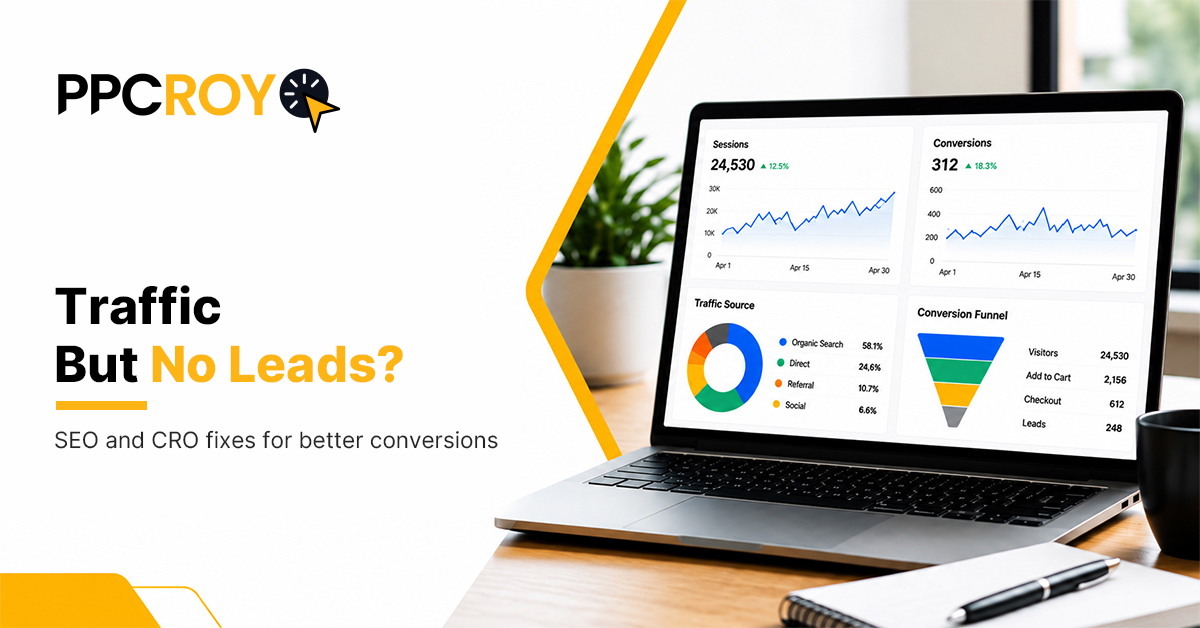
Your site has been getting visitors for months, and the numbers look fine as well. But the phone still is not ringing. If that sounds familiar, you are not the only one, and the fix is usually easier than you think.
Many businesses focus only on increasing website traffic, but traffic alone does not create leads, bookings, calls, or enquiries. What matters is what happens after people land on your website.
That is where website conversion rate optimization becomes important. Instead of chasing more visitors, CRO helps you turn the visitors you already have into real business opportunities.
The thing nobody tells you
Most small business sites turn maybe 2 to 5 percent of their visitors into leads. The really good ones hit 11 percent or more.
That gap has almost nothing to do with how many people are landing on your site. It’s about what happens after they click.
And it’s a common problem.
In HubSpot’s research, most marketers said lead generation was their biggest headache heading into 2026. It is also getting pricier to ignore, since the cost of paid clicks keeps climbing every year. So you end up paying more than ever for people who show up, glance around, and wander off.
If your site has traffic but no leads, you are basically paying for visitors who never convert.
The upside is that you can usually fix this without finding a single new visitor. Here’s how.
Getting traffic but no leads? Book a free SEO and CRO audit with PPCROY and find out where your website is losing enquiries.
The short version
When a site pulls traffic but no leads, it’s almost always one of these:
- The wrong people are showing up
- The site feels slow or difficult to use, especially on a phone
- The buttons and prompts are vague or hard to find
- The contact form asks for too much, too soon
- There’s nothing on the page that makes you look trustworthy
- The content brings people in but never points them anywhere
- Something’s leaking in a spot you can’t see
Fix two or three of these and most sites pick up within a month or two. No extra traffic needed.
Why people show up and then vanish
Picture what happens on your page. Someone lands, skims for ten or fifteen seconds, and slips out.
They might not “bounce” in the technical sense. They could even poke around a bit. But somewhere in that visit they make up their mind that your site isn’t quite right, and you never see them again.
If you’ve ever typed “why does my website get traffic but no sales” into Google, we know the feeling. It’s a real problem, but it’s also usually a fixable one.
A Quick Way to Find Where Your Website Is Losing Leads
Before you change anything, figure out which problem you’ve got. Run through these five questions.
Are people gone in under 20 seconds? Then either the wrong traffic is arriving, or the page isn’t matching what they came looking for.
Are they sticking around past 90 seconds and still not converting? That’s a trust or button problem, not a traffic one.
Do people start your form and then quit? It’s probably too long, or one field is making them pause.
Is mobile converting at less than half the rate of desktop? Your site’s rough on phones.
Are leads coming in but mostly junk? Your SEO is pulling in the wrong crowd.
The best thing is to start with whatever you said yes to first. And, don’t try to fix all seven at once; you will wear yourself out and learn nothing.
The seven real reasons your site isn’t pulling leads
Roughly in order of how often they turn out to be the problem.
1. The wrong people are finding you
The traffic’s there. It’s just the wrong audience.
Say a financial planner ranks well for “investment tips for beginners.” Nice keyword, plenty of volume, lots of clicks. Trouble is, most of those searchers are broke college students, not the clients she’s after. Looks great on a dashboard. Converts nothing. The reports stay green while the bank account doesn’t move.
Fix: It’s time to look hard at your top ten pages. Are they built around buyer searches like “hire a divorce lawyer in Austin,” or browsing ones like “what is a divorce lawyer”?
While content aimed at people who are ready to decide tends to convert far better, content aimed at people just reading around hardly converts. This is something WordStream’s benchmarks back up.
For better lead generation, your SEO strategy should target buyer-intent keywords, not only high-volume informational keywords.
2. The site is annoying to use
Google’s Core Web Vitals research shows that when a page takes more than about three seconds to load, a big chunk of people leave before they even see it. On a phone it’s even worse. It can be due to cluttered menus, popups that jump out at you, tiny text, or pages that feel hard to use.popups that jump out at you, and tiny text, and visitors are gone before they figure out what you do.
Fix: You can run your site through Google PageSpeed Insights and aim for green on Core Web Vitals. Next, it’s time to do the test that matters: open it on your own phone at a coffee shop on slow Wi-Fi. If it bugs you, it’s bugging everyone else.
A faster website improves user experience, SEO performance, and website conversion rate optimization.
3. Buttons that don’t say anything
A lot of business sites either have no clear next step or hide it three scrolls down.
“Learn More” and “Contact Us” tell people nothing. On the other side, the ones that work say exactly what is about to happen. For instance, they are “Get your free 30-minute strategy call,” or “See pricing in 60 seconds.”
Fix: Time to give every important page a one main button. It should be near the top and again at the bottom. Also, make it specific and tied to a result. And make it stand out, not as some trick, but because every bit of friction costs you.
4. Forms that scare people off
Forms are where a ton of leads quietly disappear. A long one feels like a commitment before anyone’s earned your trust.
HubSpot observed that cutting a form from eleven fields down to four roughly doubled the number of people who filled it out. Well, that’s not a small thing.
Fix: Go ahead and ask for the bare minimum first. Name, email, maybe one question. If you need more, ask later. This one’s free and takes about an hour, and the payoff is big.
Shorter forms usually help businesses increase website leads without increasing traffic.
5. Nothing says you’re trustworthy
Imagine yourself walking into a shop with no sign, no staff, no prices, and not another customer in sight. You would leave fast.
Websites are the same. If someone can’t quickly see proof that you’re real and good at this, they’ll drift to a competitor who’s showing it.
Fix: You can add at least three pieces of proof to your homepage and main service pages. Real testimonials with names and faces. Case studies with actual numbers. Client logos, awards, photos of real people instead of stock smiles.
Trust signals help visitors feel safer before they enquire, book a call, or fill out a form.
6. Content that leads nowhere
Most business blogs are great at bringing people in and useless at doing anything with them. The reader gets the answer, learns a thing and leaves. There’s no “here’s what to do next” anywhere. If your blog is a museum, of course people walk straight out.
Fix: Let’s give every post one clear next step. Sometimes a link to a service page. Sometimes a download worth grabbing. Sometimes a gentle nudge halfway through, not just a button at the end.
7. The funnel leaks where you can’t see it
Sometimes when everything looks fine, it’s still leaking in one specific spot. Maybe people love the homepage but vanish the second they hit pricing. Maybe they start the form and never send it. You can’t fix what you can’t see.
Fix: Why not install a free tool like Microsoft Clarity and watch ten real visitor sessions. You’ll usually spot the leak within an hour, and it’s nearly always smaller than you feared.
What Good Website Conversion Rates Look Like in 2025–2026
Before you decide your numbers are bad, here’s roughly what real businesses hit:
| Industry | Average | Top 10% |
| B2B services | ~2.7% | ~8.4% |
| Ecommerce | ~2.1% | ~5.9% |
| Local services (plumbing, legal, etc.) | ~3.9% | ~11.2% |
| SaaS / tech | ~1.9% | ~6.6% |
| Healthcare | ~3.2% | ~9.1% |
| Finance / insurance | ~5.1% | ~13.0% |
Based on publicly reported WordStream and Unbounce data. The exact numbers move around between reports, so treat these as ballpark.
If you’re sitting at or below the average column, there’s real money on the table.
The goal is not only to get more website traffic. The real goal is to convert more of that traffic into leads, calls, bookings, enquiries, and sales.
A Two-Week Plan to Increase Website Leads
Work through these in order. Nothing fancy.
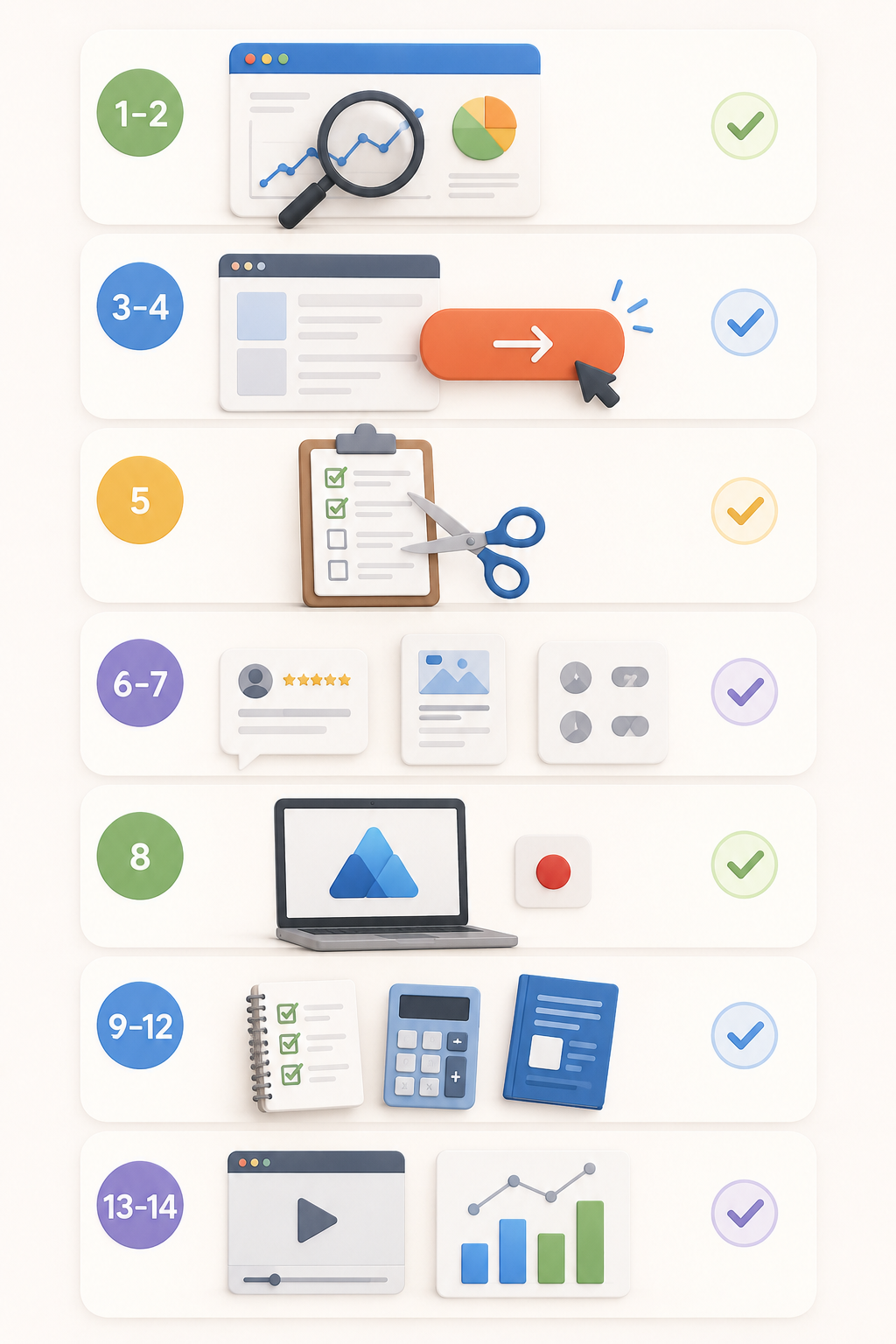
Day 1–2: You would open Google Analytics, check your top ten pages, and ask whether they’re pulling in buyers or browsers.
Day 3–4: Next, you go back through those pages and make every button specific and result-focused.
Day 5: As the next step, it’s time to count your form fields. More than five? Start cutting.
Day 6–7: Also, add three trust signals. One testimonial, one case study, one client logo. This week.
Day 8: Proceeding, turn on Microsoft Clarity and let it record.
Day 9–12: Moving on, it’s time to build one lead magnet. A checklist, a calculator, a short guide people actually want.
Day 13–14: Next, sit and watch the recordings, then compare the 30 days before your changes to the 30 days after. The numbers will point you to what’s next.
A few myths worth dropping
“More traffic means more leads.” Not really. If you’re converting at half a percent, doubling traffic just doubles the waste. Fix conversion first, then scale.
“A prettier site converts better.” Not on its own. Plenty of plain sites convert well because they’re clear, fast, and trustworthy. Pretty without function is just costly decoration.
“SEO fixes everything.” SEO gets the right people to the door. CRO is what turns them into leads. One without the other is a wider funnel on a leaky bucket.
“If they didn’t convert, they weren’t serious.” Sometimes, sure. Often not. Most people who leave without acting were close. They just didn’t get the nudge or the reassurance they needed right then.
When to Stop Tinkering and Get Help
A few signs it’s time for an outside set of eyes:
You’ve been fiddling for six months and the conversion rate hasn’t budged. You’re spending real money on traffic and can’t tell what’s working. Your team’s too close to the site to see the obvious problems. Or you’ve got conflicting advice from three different people and no idea who’s right.
If any of that rings true, a proper SEO or CRO audit usually pays for itself within a quarter.
Where PPCROY Fits in
Most agencies pick a side. SEO shops chase traffic. CRO people chase conversions. Both are useful, but if you only fix one half, you’ve still got a leaky bucket.
We run both together. SEO brings in buyer-intent traffic, CRO turns that traffic into leads, and what we learn on each side keeps improving the other. That’s how a site goes from “traffic but no leads” to “more leads than we can keep up with,” without spending more on ads.
At PPCROY, you can hire digital marketing experts who focus on SEO, CRO, landing pages, tracking, and lead generation together.
FAQs
1.Why does my website get traffic but no leads?
Usually one of seven things: the wrong audience, slow loading, weak buttons, scary forms, missing proof, dead-end content, or a hidden leak. Most sites have two or three at once.
2.How do I turn visitors into leads?
Match your traffic to buyers, sharpen your buttons, shorten your forms, add proof, speed up the site, and give every page one obvious next step.
3.How long does a fix take?
Most sites see movement in 30 to 60 days. Small tweaks, like rewriting a button, can show up inside a week.
4.SEO or CRO first?
If you’ve already got traffic but no leads, start with CRO. No point pouring more people into a site that isn’t converting.
5.What’s a good conversion rate?
Depends on your field. B2B services average around 2.7 percent, local services closer to 4. Strong performers anywhere sit at 8 percent or more.
6.Can I improve conversions without more traffic?
Yes, and it’s usually the smarter first move. Plenty of businesses roughly double their leads just by fixing buttons, forms, and proof.
7.Do I really need a CRO audit?
If your site’s had steady traffic for three months and leads haven’t moved, it’s worth it. A good audit shows you exactly where people are slipping away.
Where these numbers come from
The figures here come from recent research by Forbes Advisor, WordStream, HubSpot, and Google’s Web Vitals docs. These are the same sources serious SEO and CRO teams use when they build benchmark reports. A few of the exact percentages move between reports, so it’s worth checking the latest published version before you treat any single number as final.
What to do next
If your site’s been pulling traffic but no leads for months, book a free SEO and CRO audit with our team. We’ll show you where visitors are dropping off and what to fix first.
Not ready for a call? Grab our free Website Conversion Audit Checklist, the same one our specialists use on new client sites.
Helpful Reads on This Site
- AI Search Optimization: How Brands Can Rank in ChatGPT, Gemini, and Google AI
- AI Overview Ranking in 2026: Improve Google AI Visibility
- 5 Common Google Ads Mistakes to Avoid in 2026
- The Future of Search: How Voice Search Is Changing SEO in 2026
- Top AI Tools Business Owners Should Know About for Digital Marketing in 2026
- Accelerate Brand Impact Through PPCROY’s Next-Gen Web Experience Architecture
The bottom line
A website that gets traffic but no leads isn’t broken. It’s leaking.
The sites quietly pulling in steady leads in 2026 aren’t the prettiest or the priciest. They’re the ones that bothered to fix the dull stuff: the buttons, the form fields, the proof that they’re worth trusting.
You don’t need more visitors. You need more of the ones you already have to do something.
That’s about it. Most businesses are sitting on a pile of under-converting traffic and haven’t noticed. The ones who sort it out this quarter, instead of next year, are the ones pulling ahead while everyone else keeps throwing money at the top of the funnel.
If you want a hand getting there, that’s what we do. Book a free audit and you’ll see where the leaks are within about half an hour.
About PPCROY
PPCROY is a results-driven digital marketing and growth agency focused on helping businesses generate more qualified leads, improve conversions, and scale revenue through strategic online marketing. The team provides expert support across services such as SEO, Google Ads, Meta Ads, funnel optimization, landing page strategy, and performance-focused digital campaigns. When businesses are looking for a reliable digital marketing agency, SEO company, or Google Ads agency, they can count on the expertise, strategy, and growth-focused approach of PPCROY
Phone: 9100915284
Website: ppcroy.com