
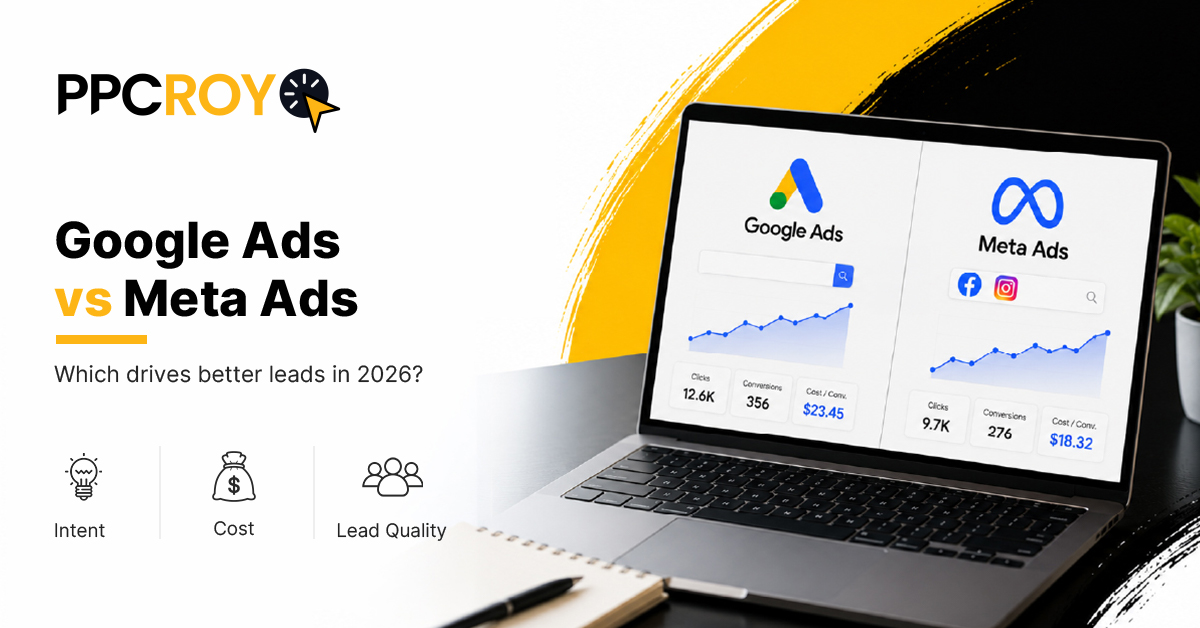
You’ve probably had this exact conversation: “Should we run Google Ads or Facebook Ads?” Whoever answers usually picks the platform they know better.
That’s not a strategy. That’s a coin flip. Here’s what the data actually says in 2026.
Introduction
Ads will be crossing $1 trillion globally in 2026 for the first time ever, as per a new prediction by Statista! And where did most of that money go? Straight to our screens!..A major share of global ad spending now goes to digital channels—Instagram Reels, YouTube ads, Google searches, apps, influencers… you name it. Two companies are quietly splitting most of it.
Google and Meta will pull in around $229 billion and $215 billion in ad revenue respectively this year, per eMarketer. That’s roughly half of every digital ad dollar spent on the planet.
When business owners wonder whether they should choose Google Ads or Facebook Ads, they’re really deciding where to invest across two of the biggest advertising platforms on Earth.
The Wall Street Journal recently covered how each system is essentially going to shift into total AI automated mode in 2026. Google expanded AI Max for Search, while Meta continued making Advantage+ lead campaigns central to its advertising platform.
Both promise higher lead volume with less manual work. Both quietly change what “good” looks like on their platform. And both are more expensive to run than they were even 18 months ago.
This blog compares Google Ads vs Facebook Ads for lead generation using current data and shows where each platform genuinely wins in 2026.
The Quick Version, If You’re Short on Time
Google Ads captures demand. Facebook Ads creates it.
If you’re selling something people are actively looking for (legal assistance, plumbing repair, software), Google Ads for lead generation is nearly always the best in quality. If you’re selling something people don’t know yet that they want (new product, lifestyle brand, course) Meta Ads for lead generation is generally the best on volume and price.
Most small businesses do need both but not 50/50. You have to consider who your customer is, your margins, your sales cycle and how long you’re willing to wait for leads to convert.
The Real Problem: Why Most Businesses Pick the Wrong Platform
Here’s how the conversation usually goes.
A business owner reads an article saying Facebook Ads are cheaper. They shift the budget over. Leads come in but the sales team says they’re junk.
Next quarter they read another article about Google Ads for small business. They move the budget back. Leads slow down but close rates go up.
Six months of budget swings later, they’ve learned nothing except that both platforms are “kind of working, kind of not.”
This is the trap. Comparing cost per lead Google Ads vs Facebook Ads without factoring in lead quality is how you end up spending money on both platforms without really winning on either.
What Are Google Ads vs Meta Ads?
Brief to avoid confusion as names get muddled!
Google Ads is Google’s advertising platform for Search, YouTube, Gmail, Google Maps and the Google Display Network. The large majority of leads will come via the search where the search user types a phrase.
Meta Ads is Meta’s advertising platform for Facebook, Instagram, Messenger and WhatsApp. These ads appear across feeds, Stories, Reels and messages, with delivery based largely on audience and conversion signals.
The difference is important. Google Ads goes to people actively searching. Meta Ads goes to people passively scrolling. That single distinction shapes almost every difference between the two.
Why This Comparison Matters More in 2026
Costs have jumped. In many industries, these platforms are more expensive and competitive than they were 18 months ago.
For example, according to Forbes Advisor data, Google Ads CPCs have increased approximately 10 to 15 percent year-over-year since 2023. Meta CPMs have climbed similarly according to Search Engine Journal reporting.
AI took over both platforms in 2026. Google Ads AI Max launched globally in January. Meta Advantage+ leads campaigns became the default in most accounts.
Both platforms can now automate large parts of targeting, bidding, placements and creative delivery. That’s convenient. It’s also risky if you don’t understand what the AI is optimising for.
The best ad platform for lead generation is a more important choice in 2026 than it was in 2022. The cost of choosing the wrong ad platform can increase more quickly today.
Google Ads for Lead Generation: What It’s Actually Good At
Google Ads works well when customers already know they have a problem and are actively searching for a solution.
The person typing “emergency plumber near me” has clear purchase intent. They don’t need to be convinced that they need a plumber. They need help now.
That’s why Google Search Ads vs Facebook Ads almost always favors Google for high-intent lead generation.
Where Google Ads Wins
High-intent industries. Legal, medical, home services, B2B software. People search for specific queries. Ads catch them mid-decision.
Bottom-of-funnel conversions. Google Ads reaches buyers who are ready to act instead of warming them up from the beginning.
Measurable ROI. An average conversion rate for Google Search Ads, of 4-6%, is also greater than most of other available channels, based on WordStream data.
Trust factor. People trust search results more than social feeds, which shows up in close rates.
Where Google Ads Struggles
Cost. If you’ve run ads for lawyers, insurance agents, or finance brands… you already know. Clicks are super expensive. Some of the highest CPCs in all of digital advertising live in these industries.
Volume ceiling. You can only reach as many people as are actively searching. In some niches, that’s not many.
Brand building isn’t its strength. Google Ads is a demand-capture, not a demand-creation, channel.
Facebook Ads (Meta Ads) for Lead Generation: What It’s Actually Good At
Facebook & Instagram allow you to find people who are not looking for you. This sounds like a disadvantage, but it is the biggest advantage Facebook can provide.If you’re in a new category or niche, your product is visually appealing or the purchase is emotionally driven, Facebook Ads for lead generation may outperform Google for reach and initial acquisition cost.
Where Meta Ads Win
Lower cost per click. When you’re on a tighter budget, the difference is usually pretty stark. According to the DesignRush 2026 Benchmark Report, the cost per click for Meta ads is only about one-third of the cost per click for Google Ads across most industries.
Massive reach. Collectively, Facebook and Instagram have over 3 billion monthly active users across the world.
Better for visual products. Fashion, fitness, home goods, food, courses. Anything that photographs or films well.
Great for retargeting. Meta’s retargeting tools are still some of the most sophisticated in the industry.
Lookalike audiences. Give Meta your customer list, and it’ll find more people like them faster than any other platform.
Where Meta Ads Struggle
Lead quality. This is the number one complaint. Why Facebook Ads leads are low quality is a top search query for a reason.
People fill out lead forms while scrolling. They forget they submitted them. Sales teams call and hear, “Who is this?”
Long consideration cycles. Meta struggles with high-ticket B2B or long sales cycles where trust needs to be built over months, not minutes.
Learning phase volatility. Advantage+ leads campaigns can be brilliant or terrible depending on setup, and it takes real spend to figure out which.
Cost Per Lead vs Cost Per Closed Customer
Here’s where most comparisons get lazy. They compare cost per lead without factoring in whether the leads actually close.
Meta almost always looks cheaper on the surface. But that’s not the whole story.
Say Meta gives you leads at $40 and Google at $85.
Looks like Meta wins, right?
Not so fast. If only 8% of Meta leads actually buy, but 22% of Google leads do… suddenly Google is the cheaper customer.
The math flips.
Meta: $40 / 8% = $500 per customer.
Google: $85 / 22% = $386 per customer.
Google wins, even though its leads look “expensive” on the surface.
This is exactly why Google Ads leads are expensive but often still worth it. And why Meta Ads lead quality matters more than raw CPL.
Stop obsessing over “cost per lead.”
Start obsessing over “cost per qualified lead.”
Search Ads vs Social Ads: Which Should You Actually Pick?
Here’s the simple framework I use to decide — and it actually works!
Pick Google Ads When:
- Your customers already search for what products or services you sell
- Your product solves an urgent, specific problem
- You have a high-ticket offer with strong margins
- Your sales team can handle a lower volume of higher-quality leads
- Your industry has clear commercial and buyer-intent keywords
Pick Meta Ads When:
- Your product is visually driven or emotionally sold
- Your customers don’t know they need it yet
- You want volume and are okay filtering aggressively
- Your product is impulse-friendly or lower-ticket
- You have strong creative assets (video especially)
Run Both When:
- You have budget for at least $3,000 per month across both platforms
- You need to build brand awareness and also capture demand simultaneously
- Your sales cycle involves multiple touchpoints before purchase
- You want to retarget Meta warm audiences with Google Search ads later
For most small businesses, the answer is both, but weighted differently based on the industry. Local services usually run 70/30 in Google’s favor. Ecommerce and lifestyle brands usually flip to 70/30 Meta.
Google Ads AI Max vs Meta Advantage+: The 2026 AI Face-Off
Both platforms are betting everything on AI in 2026. Here’s what actually changed.
Google Ads AI Max
Launched globally in January 2026, AI Max removes keywords from Search campaigns entirely.
You give it a landing page, a budget, and a goal. Gemini 3 handles the rest.
Best for accounts with 100+ monthly conversions and clean tracking. Risky for smaller accounts or new campaigns without data history.
Meta Advantage+ Leads Campaigns
Meta’s answer to full automation. You provide creative and a target CPL, and Meta’s AI handles audience, placement, and bidding.
Advantage+ works surprisingly well for ecommerce and lead-gen offers with strong creative. It falls apart quickly with weak creative or unclear conversion signals.
The Honest Comparison
Both AI systems optimize for volume and conversion signals, not necessarily profit. If your conversion tracking is fuzzy, both will produce fuzzy results.
The advertisers winning with either AI system share the same trait. They know what the AI is optimized to do and guide it instead of trusting it.
How to Improve Lead Quality From Ads (Both Platforms)
Whichever platform you choose, these fixes can help improve lead quality overall.
Tighten your qualifying questions. Add a budget or timeline question to your lead form. Junk leads self-filter out.
Track offline conversions. Feed your CRM data back into both platforms. Google and Meta AI both use closed-loop data to find better leads.
Match keywords to intent, not just topic. “Emergency” beats “tips” every time.
Improve your landing pages. Fast load times, clear CTAs, matching headlines, minimal form fields.
Use negative audiences and negative keywords aggressively. Both platforms let you exclude low-value segments. Most advertisers underuse this.
Test creativities regularly. On Meta especially, tired creative can quickly hurt engagement, lead volume and lead quality.
How to Lower Cost Per Lead (Both Platforms)
Stop chasing new keywords. Fix what you already have.
On Google Ads: Improve Quality Score. Take a QS 4 keyword to a QS 8 and watch your CPC fall by 30%+. That’s the easiest money you’ll make on Google Ads.
On Meta Ads: Refresh creative when frequency rises and engagement, conversion rate or lead quality begins to decline.
On both: Build a proper negative keyword or audience list. Cut waste before it costs you.
On both: Improve landing page speed. Under 2.5 seconds on mobile is the modern floor.
On both: Simplify your conversion tracking. Fewer, cleaner conversion events beat dozens of noisy ones.
Common Myths Worth Clearing Up
Myth: Facebook Ads are always cheaper.
Cheaper per click, yes. Cheaper per closed customer? Not usually. Always run the full math.
Myth: Google Ads are only for big businesses.
That’s not true. Local service businesses actually get some of the best returns from Google Ads. Used to be, it was too expensive to make sense. Not anymore.
Myth: Meta Ads don’t work for B2B.
It is not true that Meta Ads are not an option for B2B businesses. It has increased its reach in this industry, but mainly at the top level for general brand awareness instead of a direct sale at the bottom level.
Myth: You should let AI handle everything.
Nope. Google and Meta both push full automation. But the accounts winning are the ones where humans still steer the strategy.
Myth: One platform is objectively better.
Neither is. Both are stellar platforms in their respective roles and with the right target audience and business model.
When to Take Action
If any of these sound familiar, your lead cost is steadily marching upward, it has been for the past six months.
Lead numbers may look reasonable, but the percentage of leads becoming appointments or customers continues to decline.
Your media mix consists of just a single channel and you’re hitting a growth plateau. Your agency has “tested” Meta/Google on and off for over 12 months without consensus or a plan of action.
Planning a spend scale into 2026 and wondering exactly where every buck works hardest.
Companies that crack their media mix today (not next year) are those that are gaining the type of competitive edge that’s hard to overcome.
How PPCROY Actually Helps
Most agencies specialize in one platform. Google-only shops. Meta-only shops.
That works great… if you already know exactly what you need. The problem is, most people don’t. And that’s when things fall apart.
PPCROY runs both platforms together, with lead quality as the metric that matters—not vanity CPL. The team builds an ad mix based on your actual buyer, industry, and margin, not a template.
If running paid advertising for small business feels like throwing money and hoping something sticks… That’s exactly why PPCROY exists – offering a clear framework, so you stop guessing.
FAQs
Which is better, Google Ads or Facebook Ads?
Depends on your buyer. Google Ads wins when people are actively searching. Facebook Ads wins when you need to create demand or reach people visually. Most businesses benefit from running both.
Why are Facebook Ads low quality?
Because people fill out lead forms while scrolling, often without much thought. Meta lead forms auto-fill contact details, which makes submission almost frictionless, and that same friction is what usually filters out lower-intent leads on other platforms.
Why are Google Ads leads expensive?
Because Google Ads reaches people at the exact moment they’re ready to buy. Higher intent means higher competition, which pushes CPC up. Expensive isn’t the same as bad, expensive leads usually close better.
What is Google Ads AI Max?
Google’s newest campaign type that removes keywords entirely from Search. You give it a landing page and a goal, and Gemini 3 handles targeting, ad copy, and bidding automatically. Works best for mature accounts with strong data.
What are Meta Advantage+ leads campaigns?
Meta’s fully AI-driven lead generation campaigns. You provide creative and a target CPL. Meta’s algorithm handles audience, placement, and bidding. Effective for ecommerce and lead-gen offers with strong creative.
How do I lower the cost per lead?
Check these first before you touch the budget: Improve website speed, confirm that sales are tracked correctly, refresh tired Meta ads and improve Google Ads relevance and landing-page experience. And, tell Google + Meta who not to show your ads to.
How do I improve lead quality from ads?
Ask better questions in your forms. Send sales data back to the platforms. Target people who are ready to buy. Cut waste with strong negative keyword and audience lists.
Trust / Proof / Expert Insight
The data in this blog draws on verified 2025 to 2026 research from Statista, eMarketer, Forbes Advisor, WordStream, DesignRush, and Meta’s own publicly reported user data.
These are the same sources professional PPC teams reference when building industry benchmarks. Nothing made it into this guide unless it held up across multiple credible reports.
What to Do Next
If you’re stuck deciding between Google Ads or Facebook Ads for your next campaign, book a free ad strategy audit with the PPCROY team. We’ll show you exactly which platform mix fits your buyer, budget, and margin.
Not ready for a call yet? Grab our free Google Ads vs Meta Ads Decision Framework, the same tool our specialists use when planning new client campaigns.
Helpful Reads on This Site
- AI Search Optimization: How Brands Can Rank in ChatGPT, Gemini, and Google AI
- AI Overview Ranking in 2026: Improve Google AI Visibility
- 5 Common Google Ads Mistakes to Avoid in 2026
- The Future of Search: How Voice Search Is Changing SEO in 2026
- Top AI Tools Business Owners Should Know About for Digital Marketing in 2026
- Accelerate Brand Impact Through PPCROY’s Next-Gen Web Experience Architecture
- Why Your Google Ads Are Spending Money but Not Getting Quality Leads
- Zero-Click SEO in 2026: How to Stay Visible When Users Don’t Click Your Website
Wrapping This Up
Google Ads vs Facebook Ads isn’t really a “which is better” question. It’s a “which fits your buyer” question.
Google catches demand. Meta creates it. Both are more expensive and more AI-driven than they were even a year ago.
The businesses winning in 2026 aren’t the ones picking a platform. They’re the ones picking the right platform mix, and knowing when to shift the ratio.
Most small businesses guess. The ones that measure lead quality (not just cost) and match it to platform strengths are the ones quietly growing while their competitors keep flipping between Google and Meta every quarter.
If you want a proper answer for your business, PPCROY can help. Book a free audit and we’ll show you the exact platform mix that fits, usually in under 30 minutes.
About PPCROY
PPCROY is a results-driven digital marketing and growth agency focused on helping businesses generate more qualified leads, improve conversions, and scale revenue through strategic online marketing. The team provides expert support across services such as SEO, Google Ads, Meta Ads, funnel optimization, landing page strategy, and performance-focused digital campaigns. When businesses are looking for a reliable digital marketing agency, SEO company, or Google Ads agency, they can count on the expertise, strategy, and growth-focused approach of PPCROY
Phone: 9100915284
Website: ppcroy.com