
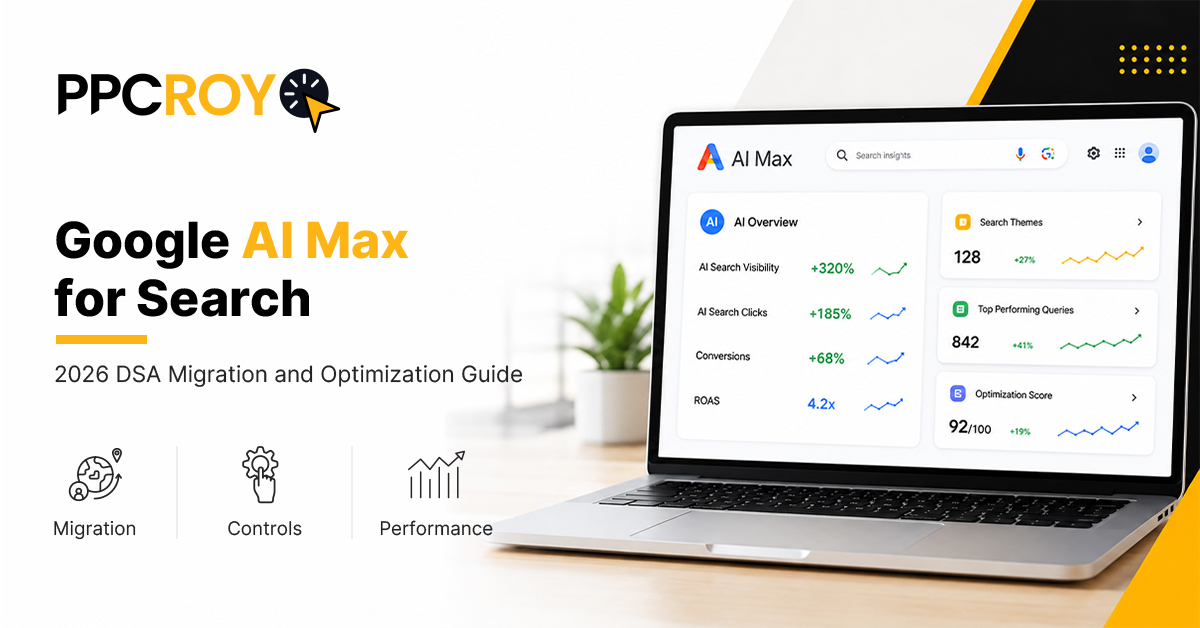
Excerpt: Google just quietly buried a 15-year-old campaign type. If you’re running Dynamic Search Ads, your February 2027 clock is already ticking, and the accounts that treat this as “we’ll deal with it later” are the ones that’ll leak the fastest. Here’s everything actually worth knowing.
Introduction
Something significant happened in Google Ads this year, and if you missed it, you’re not alone.
On April 15, 2026, Brandon Ervin, Director of Product Management at Google Ads, officially announced that Dynamic Search Ads would auto-migrate to AI Max for Search starting September 2026. Then, on June 11, 2026, Google Ads Liaison Ginny Marvin announced a delay, pushing the DSA-to-AI-Max migration to February 2027.
DSA campaign creation was restored on June 15, 2026. Meanwhile, AI Max officially moved out of beta on April 15, 2026, after an 11-month period involving hundreds of thousands of advertisers globally.
Here’s the number Google is officially quoting: advertisers using the full AI Max feature suite see an average of 7 percent more conversions or conversion value at a similar CPA or ROAS compared with using search term matching alone. For campaigns still relying heavily on exact and phrase match, that figure reportedly climbs to 27 percent.
But independent research tells a more complicated story. Smarter Ecommerce (SMEC) analyzed more than 250 retail Search campaigns using AI Max and found a median revenue lift of 13 percent, but also a median CPA increase of 16 percent, with ROAS ranging from +42 percent to -35 percent.
So AI Max works. Sometimes brilliantly. Sometimes disastrously. And the difference almost always comes down to how well it’s configured.
This blog is the complete 2026 guide to Google AI Max for Search: what it actually is, every feature and control, the DSA migration timeline, real performance data, and how to optimize AI Max campaigns properly.
The Quick Version, If You’re Short on Time
AI Max for Search is Google’s suite of AI-powered targeting and creative features built into your existing Search campaigns. It’s not a new campaign type. It includes three core capabilities: search term matching, text customization, and final URL expansion.
Key dates:
- April 15, 2026: AI Max moved out of beta
- September 2026: Automatically Created Assets (ACA) and campaign-level broad match still auto-migrate to AI Max on the original schedule
- June 15, 2026: DSA campaign creation was restored
- January 2027: New DSA campaign creation ends
- February 2027: DSA auto-migration begins for all remaining campaigns
Bottom line: If you’re running DSA, you have a runway—not a reprieve. Use that time to run controlled AI Max experiments instead of waiting until the migration deadline.
The Real Problem: Most Advertisers Don’t Understand What’s Changing
Here’s how a lot of teams are thinking about this right now:
“We got another six months. We’ll figure it out closer to February 2027.”
That’s the trap.
AI Max is already becoming increasingly central to Google’s Search campaign framework., based on Google’s own testing showing faster time-to-first-conversion. And ACA plus campaign-level broad match still migrate in September, making that the more immediate deadline.
So even if you never touch DSA, if you have ACA or campaign-level broad match in your Google Ads account, September is your real deadline.
If you’ve searched “how to migrate DSA to AI Max” or “should I enable AI Max for Search,” you already know how much confusion exists around the transition. This guide clears it up.
What is Google AI Max for Search?
Let’s start with a clear definition.
Google AI Max for Search is a suite of AI-powered targeting and creative enhancements built into standard Google Search campaigns. It brings Google’s Gemini AI capabilities into your existing Search campaigns without requiring you to launch an entirely new campaign type.
Introduced in beta on May 6, 2025, by Google’s Brian Burdick, Senior Director of Product Management at Google Ads, AI Max reached general availability on April 15, 2026.
Since launch, Google reports that AI Max for Search has become the fastest-growing AI-powered Search ads product in the platform’s history.
The Three Core Features
AI Max centers around three core capabilities inside a Search campaign:
1. Search Term Matching. Expands beyond your keyword list using AI to identify related queries with buyer intent. Effectively broad match plus keywordless targeting.
2. Text Customization. Google’s AI generates ad copy variations pulled from your landing pages and existing assets, matching each query to the best-fit headline and description.
3. Final URL Expansion (FUE). AI selects the best landing page on your domain for each search query, not just the URL you assigned to the ad group.
You can enable them individually. But Google’s benchmarks show the biggest lift when all three run together.
Why This Matters More in 2026
Two things happened this year that make understanding AI Max non-negotiable.
First, AI Overviews reduced paid CTR by 68 percent on informational queries, per Involve Digital’s 2026 research. High-intent transactional queries were unaffected. Which means the paid auction is compressing around fewer, more expensive high-intent clicks.
Second, median Google Ads CPCs rose 12.88 percent year over year and median CPA increased 12.35 percent to $23.74 in 2026, per Foundry CRO benchmarks. Meaning the cost of poorly configured campaigns is now higher than ever.
AI Max is Google’s answer. Automate the targeting, expand the matching, let Gemini find the queries humans wouldn’t have thought of. Whether that works for your account depends entirely on setup.
AI Max Features Deep Dive
Now let’s break down every feature in detail, because this is where most guides fall short.
1. Search Term Matching (Keywordless Targeting)
This feature expands your ad’s reach beyond your existing keyword list.
Instead of only matching to keywords you’ve added (even broadly), AI Max analyzes your landing pages, brand context, and campaign signals to find queries you never manually targeted.
When it helps: Accounts with narrow keyword lists that are missing relevant search demand. Especially useful for services or products with many long-tail variations.
When it hurts: Accounts without solid negative keyword lists. Search term matching will happily spend on queries that look related but aren’t.
2. Text Customization
Google’s AI generates ad copy variations based on your existing assets and landing pages.
Each search query gets matched to the most contextually relevant headline and description combination. So a search for “emergency plumber Boston” might get a different headline than “24-hour plumbing service near me,” even though both trigger the same ad group.
When it helps: Broad campaigns with many query variations. Text customization improves ad relevance and Quality Score.
When it hurts: Regulated industries where specific copy is legally required. Google added text disclaimers in April 2026 to solve this, ensuring required text always appears in ads even when text customization is on.
3. Final URL Expansion (FUE)
This is the most powerful, and riskiest, AI Max feature.
Instead of always sending traffic to the URL you assigned to an ad group, FUE lets Google’s AI pick the best landing page on your domain for each specific query.
Google describes FUE as essential because “as searches become more conversational and unique, it’s become impossible to manually choose the right page for every query.”
When it helps: Sites with many well-optimized landing pages and clean site architecture. FUE can lift conversions significantly by matching intent to the right page.
When it hurts: Sites with weak pages, outdated blog content, or pages that shouldn’t rank commercially. Without URL exclusions, FUE will send paid traffic to any page it thinks is relevant.
Critical setting: Landing page exclusion lists let you specify URLs that AI Max should never use as a final URL. This was a glaring omission at launch and is now considered essential for any AI Max account.
4. Brand Controls
You can now include or exclude brand names from your ads.
Example: An advertiser selling only Nike and Adidas can designate brand inclusions for those and exclude “Reebok” queries entirely.
5. Location Controls
Standard geo-targeting still applies. But AI Max also lets you signal preferred regions where the AI should focus expansion efforts.
6. URL Exclusions
The most important control most advertisers ignore. You can tell AI Max which URLs on your domain to never send traffic to (blog pages, outdated product pages, career pages, thin content, etc.).
7. AI Brief and Text Disclaimers (Launched May 2026)
At Google Marketing Live 2026, Google announced two more control features:
AI Brief: Lets you give AI Max specific instructions about brand tone, messaging preferences, and matching requirements.
Text Disclaimers: Guarantees that required legal or compliance text always appears in ads, even when text customization and FUE are both on.
Together, these features close what was previously a major gap for regulated industries.
AI Max vs Dynamic Search Ads: The Real Differences
Here’s where the DSA-to-AI-Max migration story gets clearer.
Dynamic Search Ads crawl your website and generate ads based on page content. Simple, well-understood, been around since 2011.
AI Max goes further. It uses real-time intent signals and behavioral data, dynamically generates headlines and descriptions per query, and includes Final URL Expansion routing users to any page on your site Google deems relevant.
The biggest operational difference is FUE. It increases coverage but can send traffic to pages you have not optimized for conversions. Which is exactly why the delayed migration matters, most accounts need time to build proper URL exclusion lists before losing DSA control.
AI Max vs Performance Max: Not the Same Product
This confuses everyone. Let’s settle it.
Performance Max runs across all Google inventory (Search, YouTube, Display, Gmail, Discover, Maps) and operates with minimal advertiser control. Basically a black box.
AI Max stays within Search and Search Partners only. It maintains full search term reporting and preserves keyword-level negative keyword capabilities.
Google explicitly recommends running both together, describing the combination as a “Power Pack.” One replaces demand-capture Search infrastructure; the other extends reach across other Google surfaces.
They’re not competitors. They’re complementary layers.
DSA to AI Max Migration Timeline
Here’s the definitive timeline. Bookmark this.
April 15, 2026: Google announces DSA auto-migration to AI Max. Original deadline: September 2026.
June 11, 2026: Google Ads Liaison Ginny Marvin announces the extension to February 2027.
June 15, 2026: DSA campaign creation restored.
June 2026 – January 2027: Voluntary migration period. Manual upgrades available with full control.
September 2026: ACA and campaign-level broad match still auto-migrate on the original schedule.
January 2027: New DSA creation ends.
February 2027: Automatic migration begins for all remaining active DSA campaigns.
Why the Delay Happened
Google cited advertiser feedback and the need to avoid disrupting Q4 peak season. In Marvin’s words:
“We’ve heard your feedback loud and clear: you need more time to transition from Dynamic Search Ads to AI Max.”
The delay applies specifically to DSA. It does not apply to ACA or campaign-level broad match, both of which still migrate in September 2026.
Real AI Max Performance Data (What Actually Works)
Here’s where honesty comes in.
Google’s Official Benchmark
Google claims advertisers using AI Max typically see 14 percent more conversions or conversion value at a similar CPA. For campaigns still relying heavily on exact and phrase match keywords, that figure reportedly climbs to 27 percent.
Google’s most recent official number (June 2026) is 7 percent more conversions at a similar CPA/ROAS when using the full feature suite versus search term matching alone.
Important caveat: The 14 percent benchmark explicitly excludes retail advertisers.
Independent Retail Data (Smarter Ecommerce, 250+ Campaigns)
The SMEC analysis of 250+ retail campaigns found:
- Median revenue lift: +13 percent (close to Google’s claim)
- Median CPA increase: +16 percent
- ROAS spread: +42 percent to -35 percent
Only 22 percent of campaigns hit their original ROAS targets.
What This Actually Means
AI Max is not a guaranteed win. It works best for:
- Accounts with $750+/day budgets and 100+ monthly conversions
- Clean conversion tracking
- Solid negative keyword governance
- Well-optimized landing pages across the site
- Existing broad match experience in the account
If you don’t have those foundations, enabling AI Max often just makes waste happen faster.
Should You Enable AI Max for Search?
Here’s the practical framework.
Enable AI Max When:
- You have 100+ monthly conversions per campaign
- Your conversion tracking is clean and current
- You have a comprehensive and actively maintained negative keyword list
- Your landing pages across the site are conversion-ready, not just your key ones
- You’ve had success with broad match in the past
- You have budget headroom to test (roughly 15x target CPA as daily budget)
Wait or Skip AI Max When:
- Conversion tracking is broken or inconsistent
- Your negative keyword list is thin
- You have one strong landing page surrounded by mediocre ones
- Broad match has consistently underperformed in your account
- You’re already budget-constrained
- You’re in a highly regulated industry without AI Brief configured
Neither answer is wrong. But blindly enabling AI Max on an account that isn’t ready is the fastest way to explain a budget overrun to leadership.
AI Max Setup: How to Configure It Properly
If you’re ready to enable AI Max, here’s the sequence.
Step 1: Build Your Foundation First
Before touching any AI Max toggle:
- Verify conversion tracking with test conversions
- Import GA4 conversions into Google Ads
- Audit your negative keyword list (aim for 200+ account-level negatives at minimum)
- Review every landing page on your domain and note which ones should never receive paid traffic
Step 2: Enable One Feature at a Time
Don’t turn all three on at once.
Start with search term matching. Let it run for 14 to 21 days. Review the search terms report. Add negatives aggressively.
Then enable text customization. Monitor Quality Score and CTR changes.
Only then enable Final URL Expansion. This is where the budget can leak fastest, so configure URL exclusions before turning FUE on.
Step 3: Configure Controls
Set brand inclusions and exclusions. Set location signals. Build your URL exclusion list.
If you’re in a regulated industry, configure AI Brief and enable text disclaimers.
Step 4: Set Up AI Max Reporting
Google preserved full search term reporting inside AI Max, unlike Performance Max. Use it.
Review the AI Max search terms report weekly for the first 60 days. Look for:
- Queries that don’t match your buyer intent
- URLs that FUE selected but shouldn’t have
- Ad text combinations that hurt Quality Score
Step 5: Run Campaign Experiments
Google’s built-in experiment feature lets you A/B test AI Max against your current setup. This is the safest way to know whether AI Max actually helps your account before committing.
Run for at least 30 days with a 50/50 traffic split. Measure at the account level, not just at the campaign level.
AI Max Migration Checklist (For DSA Advertisers)
If you have DSA campaigns and the February 2027 clock is running, here’s what to do now:
Now (June-August 2026):
- Document current DSA performance baselines
- Export negative keyword lists from all DSA campaigns
- Note all landing pages currently receiving DSA traffic
- Prepare for the September 2026 ACA and broad-match migration (separate deadline)
September 2026:
- ACA and campaign-level broad match auto-migrate. Configure AI Max controls on affected campaigns before the switch.
October-December 2026:
- Run structured experiments comparing DSA vs AI Max at the campaign level
- Build URL exclusion lists based on FUE test data
- Refine negative keyword governance
January 2027:
- Last chance to create new DSA campaigns before creation ends
- Voluntary migration for any remaining DSA campaigns
February 2027:
- Auto-migration completes for all remaining DSA campaigns
Every DSA account ends up on AI Max eventually. The change is that you now have runway to prepare rather than react.
Common Mistakes and Myths About AI Max
Myth: AI Max replaces Performance Max.
They’re complementary. Google explicitly recommends running both, describing the combination as a “Power Pack.”
Myth: AI Max works for every account.
Ecommerce data shows a wide spread from +42 percent to -35 percent ROAS. Retail was explicitly excluded from Google’s 14 percent benchmark. It’s not universal.
Myth: Just turn all three features on and let Google handle it.
Enabling all three at once without URL exclusions or negative governance is the fastest way to burn the budget. Layer them in sequence.
Myth: DSA is dead. Turn it off now.
DSA creation was restored in June 2026 and remains valid through January 2027. The auto-migration is February 2027. Use this time to run controlled tests instead of a panicked switch.
Myth: AI Max is just a broad match with a new name.
Broad match is just query matching. AI Max also handles ad copy generation, landing page selection, and creative rotation. It’s a fundamentally different level of automation.
When to Take Action
If any of these describe your account, the clock is already running:
You have active DSA campaigns and haven’t started baseline testing. You use ACA or campaign-level broad match (September 2026 deadline).
Your negative keyword lists haven’t been reviewed in six months. You’ve been auto-enrolled in AI Max features via recommendations without knowing what’s on.
You’re in a regulated industry and haven’t configured AI Brief or text disclaimers.
Every week you wait, more of your account is being shaped by defaults you didn’t set.
How PPCROY Actually Helps
Most agencies specialize in the old Google Ads playbook: keyword research, manual bid management, tight match types. AI Max requires a different skill set.
PPCROY handles the full AI Max transition for clients: baseline testing against DSA, structured feature rollouts, URL exclusion governance, AI Brief configuration for regulated industries, and ongoing search term audits.
If your account has been auto-enrolled in AI Max features and you’re not sure what’s actually running, that’s exactly the audit the team runs first.
FAQs
What is Google AI Max for Search?
AI Max for Search is a suite of AI-powered targeting and creative features built into standard Google Search campaigns. It includes search term matching, text customization, and final URL expansion. It reached general availability on April 15, 2026.
How does AI Max for Search work?
Google’s Gemini AI expands your keyword matching, generates ad copy variations from your landing pages, and can automatically select landing pages based on query intent. You enable one or all three features inside your existing Search campaigns.
Should I enable AI Max for Search?
If you have 100+ monthly conversions, clean tracking, strong negative keyword lists, and good landing pages across your site, yes. If those foundations aren’t in place, wait and build them first.
When does DSA migration to AI Max happen?
DSA auto-migration was delayed from September 2026 to February 2027. New DSA creation ends in January 2027. ACA and campaign-level broad match still migrate on the original September 2026 schedule.
How do I set up AI Max for Search?
Build your foundation first (tracking, negatives, landing pages), then enable one feature at a time: search term matching, then text customization, then final URL expansion. Configure URL exclusions and brand controls before enabling FUE.
What’s the difference between AI Max and Performance Max?
AI Max stays within Search and preserves full search term reporting. Performance Max runs across all Google inventory with minimal transparency. Google recommends running both together as a “Power Pack.”
What performance can I expect from AI Max?
Google’s official benchmark is 14 percent more conversions at similar CPA (7 percent when compared feature-suite versus search term matching alone). Independent retail data from SMEC showed +13 percent revenue but +16 percent CPA, with wide variance.
How do I optimize AI Max campaigns?
Weekly search term review, aggressive negative keyword management, URL exclusion lists, campaign experiments against baselines, and Quality Score monitoring on text customization.
What to Do Next
If you have DSA campaigns or ACA and campaign-level broad match still running, book a free AI Max migration audit with the PPCROY team. You’ll see exactly which campaigns are affected by which deadline, and what to do first.
Not ready for a call yet? Grab our free AI Max Migration Checklist, the same document PPCROY specialists use when auditing new client accounts.
Helpful Reads on This Site
- AI Search Optimization: How Brands Can Rank in ChatGPT, Gemini, and Google AI
- AI Overview Ranking in 2026: Improve Google AI Visibility
- 5 Common Google Ads Mistakes to Avoid in 2026
- The Future of Search: How Voice Search Is Changing SEO in 2026
- Top AI Tools Business Owners Should Know About for Digital Marketing in 2026
- Accelerate Brand Impact Through PPCROY’s Next-Gen Web Experience Architecture
- Why Your Google Ads Are Spending Money but Not Getting Quality Leads
- Zero-Click SEO in 2026: How to Stay Visible When Users Don’t Click Your Website
- Why Your Website Gets Traffic but No Leads (and How to Fix It)
Wrapping This Up
AI Max is not optional anymore. It’s the default direction Google is taking Search advertising, and every account will eventually operate inside its framework.
The delay to February 2027 is a runway, not a reprieve. Every DSA campaign, every ACA setup, every campaign-level broad match setting eventually ends up on AI Max.
The accounts that come through the migration cleanly aren’t the ones that waited. They’re the ones that used the runway to build controls, run experiments, and prepare properly.
Google’s benchmarks look good. Independent data looks mixed. The difference between good and disastrous AI Max performance is almost entirely a governance and setup story.
If you want your migration handled properly, or just want to know if your account is quietly being reshaped by defaults you didn’t set, PPCROY can help. Book a free migration audit and you’ll walk away knowing exactly which deadlines apply to your account, and what to do first.
About PPCROY
PPCROY is a results-driven digital marketing and growth agency focused on helping businesses generate more qualified leads, improve conversions, and scale revenue through strategic online marketing. The team provides expert support across services such as SEO, Google Ads, Meta Ads, funnel optimization, landing page strategy, and performance-focused digital campaigns. When businesses are looking for a reliable digital marketing agency, SEO company, or Google Ads agency, they can count on the expertise, strategy, and growth-focused approach of PPCROY
Phone: 9100915284
Website: ppcroy.com