
Is your team publishing more AI-assisted content today than a year ago?
- Yes, a lot more (AI made it easy)
- Yes, a bit more
- About the same
- Actually less, we cut back
(If you picked A or B, the next question is whether it’s actually working. Because the 2026 data suggests it probably isn’t.)
Be honest: do you disclose when your brand uses AI to create marketing content?
- Always. It’s on every piece.
- Sometimes, when it feels right.
- Rarely. We don’t really think about it.
- Never. We prefer to keep it quiet.
(Only 20% of brands always disclose. Meanwhile, 84% of consumers want it labeled. That gap is where trust is quietly leaking.)
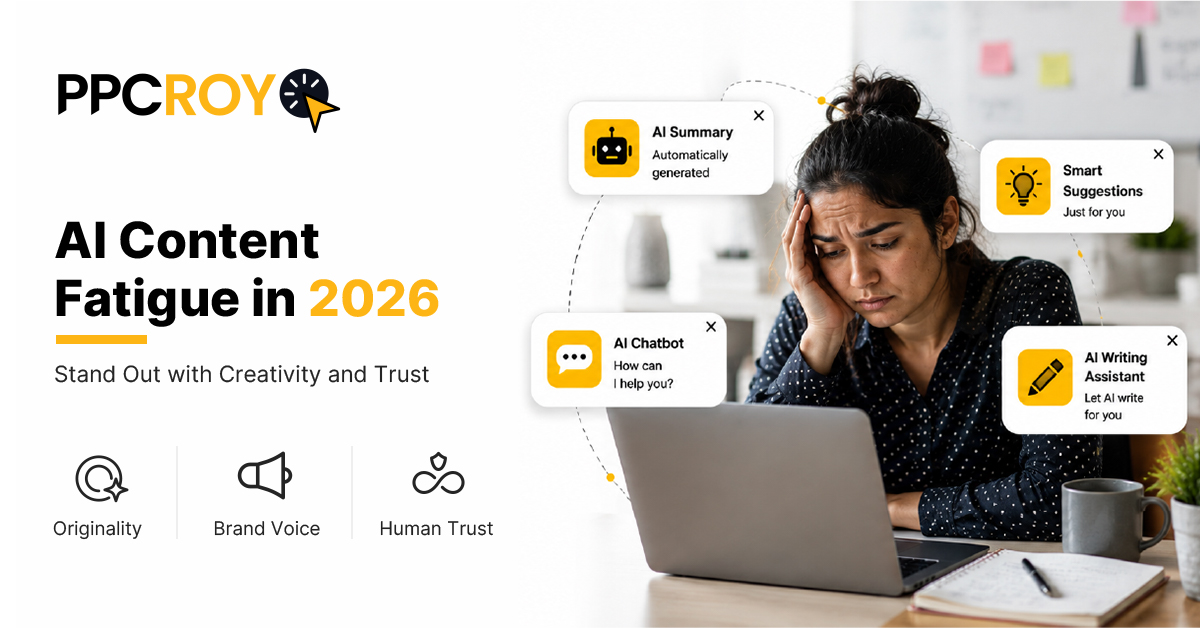
For two years, everybody sprinted to publish more AI content faster. Now consumers have learned to recognize AI-generated content quickly, and they’re becoming more critical of the brands producing it. Here’s what the data shows and what to do before it starts costing your brand trust, engagement, and conversions.
Introduction
Something quietly shifted in AI content marketing in 2026, and most content teams haven’t noticed yet.Consumer distrust of brands that use AI heavily in marketing increased from 20 percent in 2025 to 40 percent in 2026…
according to Fractl’s Q2 2026 study of 1,008 U.S. consumers. Consumer distrust roughly doubled in twelve months.
Meanwhile, only 7 percent of global consumers trust brands more when they clearly use generative AI in marketing, per Klaviyo’s 2026 AI Consumer Trends report. And when consumers notice AI-generated content in brand marketing, they’re four times more likely to trust the brand less than more, 31 percent versus 7 percent.
It gets worse. Consumer trust in AI search itself dropped from 82 percent to 54 percent in a single year, even as usage climbed 70 percent. Which means people are using AI more while trusting it less. That’s a strong AI fatigue and trust signal, not simply a usage-growth signal.
And 83 percent of consumers can now spot AI videos on sight, per Animoto’s 2026 State of Video report. 36 percent say it lowers their trust in the brand producing it.
Here’s the counterintuitive part. The generation most native to AI, Gen Z, is punishing brands the hardest. 54 percent of Gen Z say their trust would decrease if a favorite brand used AI for most marketing, versus 33 percent of Gen X and 32 percent of Baby Boomers.
This isn’t anti-technology sentiment. It’s a quality filter. Gen Z can spot generated content because they generate content themselves. And they’re penalizing brands that sound like the machine.
This is what AI content fatigue looks like in 2026. This blog covers what the data shows, why AI content fatigue is happening, and how brands are responding with stronger human creativity and brand trust.
AI Content Fatigue: The Quick Version, If You’re Short on Time
AI content fatigue is the growing consumer distrust of AI-generated marketing content, driven by oversaturation, repetitive content, sameness, and easy detectability.
The numbers that matter for 2026:
- 40 percent of consumers now trust brands less when they use AI heavily (up from 20 percent in 2025)
- 60 percent of U.S. consumers say the word “AI” in brand messaging is a turnoff
- Only 20 percent of organizations always disclose AI use; 84 percent of consumers want it labeled
- 83 percent of consumers can spot AI video on sight
- Google’s scaled content abuse penalties wiped 40 to 90 percent of traffic from sites publishing unedited AI content at volume
The brands winning right now are treating AI as a content marketing tool, not a shortcut, and putting real human creativity back at the center of customer-facing content.
The Real Problem: Why Consumers Are Turning on AI-Generated Content
Here’s what’s actually happening.
Between 2023 and 2025, marketers celebrated AI as the solution to every content bottleneck. Publish faster. Scale content. Cut costs. Get more done with fewer people.
Two years later, the internet is increasingly saturated with the results.
Same-sounding blog posts. Identical LinkedIn hooks. Generic AI-assisted case studies.Product descriptions that read like they were pulled from the same template because, honestly, they were.

Consumers noticed. Fast.
WordPress VIP’s June 2026 survey found that 60 percent of U.S. consumers say “AI” in brand messaging is a turnoff. The generation most native to AI tools is also the most suspicious of brands that rely on them.
If you’ve asked “how to avoid AI content fatigue” or “how to build trust with AI content,” you’re already ahead. Most brands haven’t clocked the shift yet. Which means the runway to differentiate is still open, but not for long.
What Is AI Content Fatigue?
Let’s define it clearly.
AI content fatigue describes growing consumer aversion to AI-generated marketing content that feels generic, repetitive, inauthentic, low-value, or clearly machine-produced.
It shows up as:
- Lower engagement on AI-written blog posts, emails, and social content
- Reduced brand trust when audiences detect AI use
- Verification behavior, consumers cross-check claims elsewhere before believing them
- Reduced click-through and conversion rates on obviously templated content
- Higher unsubscribe and unfollow rates when AI content dominates a brand’s output
It’s not that consumers hate AI. 43 percent use AI search tools daily, per Yext’s 2026 Consumer Search Behaviors Report. They use it constantly. They just don’t want brands to use it lazily on them.
That’s a different problem, and it requires a different fix.
Why AI Content Fatigue Matters More in 2026
Three things converged this year that make AI content fatigue an urgent brand-trust issue, not a future one.
1. AI-Generated Content Volume Has Exploded
Google’s March 2024 helpful content and spam updates set a goal of reducing low-quality content by 40 percent. Since then, the platform has continued tightening. The December 2025 Core Update integrated the Helpful Content System directly into the core ranking algorithm.
Sites publishing unedited AI content at scale reportedly saw 40 to 90 percent traffic losses during 2026 ranking volatility.
Affiliate review sites that hadn’t tested products lost up to 71 percent of visibility.
Publishing more AI content is now genuinely dangerous to your traffic, not just to your trust.
2. Consumers Have Learned to Detect AI-Generated Content
Two years ago, only trained editors could spot AI text at a glance. Now teenagers do it in seconds. 83 percent of consumers can spot AI video on sight, per Animoto’s 2026 report.
That means the disguise strategy, using AI but pretending you didn’t, has stopped working.
3. Brand Trust Has Become the Real Differentiator
Only 20 percent of organizations always disclose AI use to their audiences. Meanwhile, 84 to 91 percent of consumers want AI content labeled. That gap between what brands do and what consumers expect is closing, either through voluntary transparency or regulation.
Brands that move first on transparency are earning trust as a moat. Brands that stall are watching their audiences drift to competitors who feel more human.
Does Google Penalize AI Content in 2026? What It Actually Targets
Let’s clear up a big misconception because it’s costing brands money.
Does Google penalize AI content in 2026? No. Not automatically.
Google’s official position: content quality matters more than production method. AI-assisted content that meets quality standards ranks perfectly well.
What Google actually targets through its spam policies is scaled content abuse, mass-producing pages primarily to manipulate rankings, regardless of whether AI or humans wrote them.
Per Google’s spam policy documentation, the penalty triggers require three things together:
- High volume of content
- Low value to users
- Manipulative intent (rankings, not readers)
Volume alone isn’t the violation. Legitimate programmatic SEO, ecommerce catalogs, and local landing pages exist at scale and rank fine when they provide real utility.
The higher-risk pattern includes thin content, weak author or expertise signals, repetitive page structures, little original research, and limited first-hand experience.
Meaning the accounts winning after each core update aren’t the ones who stopped using AI. They’re the ones who understood what Google was actually targeting: content without genuine value, human review, or original insight.
The Rise of Human-First Content Marketing in 2026
Here’s the shift happening quietly across smart marketing teams in 2026.
Human-first content marketing is the strategy of building content around genuine human expertise, opinion, experience, and voice, using AI as a workflow accelerator rather than a replacement.
The pattern shows up consistently across brands recovering from AI penalties or winning new AI-era rankings:
- Named human authors with verifiable credentials
- Firsthand experience woven throughout, not as a footnote
- Original research, proprietary data, or unique frameworks
- Opinions and perspectives AI models can’t generate on their own
- Editorial review that goes beyond fact-checking to voice and judgment
This isn’t the same as “no AI.” It’s about being unmistakably human in the parts that matter to trust, and letting AI do the parts that don’t.
The Klaviyo research puts it starkly. 39 percent of consumers say they would trust a brand less if it used AI-generated content. But brands that clearly showed human oversight and editorial review kept their trust intact.
The difference isn’t whether you use AI. It’s obvious.
What Human-in-the-Loop AI Content Actually Looks Like
You’ll hear this phrase a lot in 2026. Let’s make it concrete.
Human-in-the-loop AI content means AI accelerates drafting or research, while a human remains responsible for the final voice, accuracy, expertise, and judgment.
In practice, that looks like:
- Subject matter experts provide outlines, key facts, and original angles
- AI drafts structure, research summaries, or first-pass copy
- Experts rewrite for voice, add firsthand examples, correct nuance
- Editorial fact-checking, bias evaluation, and legal review before publish
- Published under expert bylines with verifiable credentials
Fractl’s data shows 72 percent of organizations run human editorial review before publishing AI content. But only 54 percent add fact-checking. Only 42 percent add legal or compliance review. Only 27 percent conduct bias evaluation.
That gap is where fatigue and penalties are being manufactured. Human-in-the-loop only works when the human is actually adding value, not just approving what the AI drafted.
Why Human Creativity Wins in the AI Content Era
Here’s what most content teams miss. AI can produce infinitely more content. It cannot produce infinitely more original content.
Every AI model draws from the same training data, applies the same patterns, and reaches for the same phrasings. Which means at scale, AI content trends toward sameness.
Human creativity is the exact opposite. A single strong writer with a strong point of view can produce content no AI can match, because it comes from personal experience, opinion, and context the model never saw.
That’s why the brands winning at 2026 content aren’t the ones with the most AI. They’re the ones with:
- Real writers whose voices are recognizable
- Founders and experts who publish under their own names
- First-party data nobody else has
- Editorial risk-taking (opinions, controversial takes, personal essays)
- Original storytelling that reflects the brand, not the algorithm
The playbook is quiet but consistent. Less commodity content. More conviction. Bigger investment in each high-value piece.
How to Build Brand Trust in the AI Era
If you’re rebuilding a content strategy around brand trust, here’s what the data shows works.
1.Disclose AI Content Use Transparently
84 percent of consumers want AI content labeled. Getting ahead of this is a trust win, not a trust risk.
Simple, honest disclosure at the bottom of AI-assisted pieces works. “This article was drafted with AI assistance and edited by [named human] for accuracy and voice.” That level of transparency is now a competitive advantage.
2. Invest in E-E-A-T Signals
Google’s Experience, Expertise, Authoritativeness, Trustworthiness framework is functionally a filter now.
Add named authors with credentials, link author profiles to LinkedIn or verifiable sources, include firsthand experience explicitly, cite reputable third-party research, and demonstrate expertise through unique examples.
3. Publish Original Research and First-Party Data
Nothing separates trustworthy content from AI slop faster than original data. First-party surveys, internal benchmarks, case studies with real numbers, industry reports based on client work.
Original research earns citations, backlinks, and AI Overview mentions that recycled content simply cannot.
4.Build a Consistent Human Brand Voice
AI content sounds generic because it defaults to a middle-of-the-road, safe, corporate tone. Human writers with distinctive voices create instant differentiation.
Document your brand voice properly (not a one-line “friendly and professional” note). Give real examples. Train editors to protect it.
5. Prioritize Non-Commodity Content
Product listicles, generic how-tos, and evergreen definitions are commodity content, easily produced at scale by anyone with a ChatGPT subscription.
Non-commodity content is opinion pieces, case studies, contrarian takes, deep dives, original research, and expert essays. That’s what earns AI Overview citations and rankings that stick.
6. Use AI for Workflow, Not Voice
The best use of AI in 2026 marketing isn’t producing content. It’s speeding up:
- Research synthesis
- First-draft structuring
- Editing and proofreading
- Ideation and brainstorming
- Translation and localization
- Repurposing across formats
Human voice, human opinion, human experience. AI everywhere else.
Common AI Content Mistakes That Accelerate Content Fatigue
A few patterns show up across brands losing trust and traffic in 2026.
Mistake 1: Publishing Unedited AI Drafts
The fastest way to fatigue your audience. Even a light human editorial pass changes the perception dramatically.
Mistake 2: Using Obvious AI Phrases
“In today’s fast-paced world,” “in the ever-evolving landscape,” “unlock the power of,” “leverage the synergies of.” These phrases scream AI. Rewrite them, always.
Mistake 3: Not Disclosing AI Use
Silence about AI use, when consumers overwhelmingly want disclosure, is now read as deceptive. Transparency wins.
Mistake 4: Producing More Instead of Better
Volume was the 2023 strategy. Depth is the 2026 strategy. Cutting content output in half while doubling quality investment is a strong move.
Mistake 5: Skipping Human Bias Review
Only 27 percent of organizations conduct bias evaluation on AI content. This is the QC step that matters most for trust in sensitive topics like health, finance, legal, and politics.
Mistake 6: Ignoring Original Voice
AI content sounds generic by default. Documented, protected brand voice is the moat.
Mistake 7: Chasing AI Trends Instead of Human Insights
Every trend piece written by ChatGPT is one of thousands. A single well-reported piece grounded in original interviews or proprietary data beats every one of them.
The AI Content Quality Checklist 2026
Before publishing any AI-assisted content in 2026, run through this list.
- Has a named human author with verifiable credentials
- Contains original insight, opinion, or firsthand experience
- Includes at least one piece of proprietary data or original research
- Cites reputable third-party sources with real hyperlinks
- Fact-checked by a human against original sources
- Rewritten from AI draft to match brand voice
- Passes bias evaluation on sensitive topics
- AI use is transparently disclosed (or clearly not needed)
- Provides genuine value beyond what a reader could get from ChatGPT directly
- Would you personally send this to a friend as useful?
If a piece can’t check most of these boxes, it shouldn’t publish. The cost of adding to AI slop is higher than the cost of publishing nothing.
When to Take Action
If any of these describe your content operation, the time to shift is now:
Your organic traffic has flattened or dropped over the last two quarters. Your engagement metrics on newer content are lower than on older pieces. Your team is producing more content than a year ago but seeing less impact.
You’ve been publishing AI-assisted content without human editorial review. You’re not disclosing AI use anywhere on your site. Your named authors are generic or non-existent.
Every quarter you wait, the fatigue penalty compounds. And Google’s core updates keep tightening the screws.
How PPCROY Helps With Human-First AI Content
Most content agencies fall into one of two camps in 2026. Some still pretend AI doesn’t exist and charge premium rates for slow, expensive human writing. Others quietly scale AI content with minimal oversight and hope Google doesn’t notice.
PPCROY uses a hybrid human-first AI content model built for the 2026 trust landscape…: AI-assisted workflow for speed, expert human oversight for voice and accuracy, transparent disclosure to audiences, original research and proprietary data baked into every piece.
If your content team has been producing more but seeing less impact, that’s exactly the audit the team runs first.
FAQs
What is AI content fatigue?
AI content fatigue is the growing consumer distrust and disengagement with AI-generated marketing content that feels generic, templated, or clearly machine-produced. In 2026, 40 percent of consumers say heavy brand AI use decreases their trust.
Does Google penalize AI content in 2026?
No, not automatically. Google penalizes scaled content abuse, mass-produced pages designed to manipulate rankings, regardless of whether AI or humans wrote them. AI-assisted content with genuine value, human oversight, and E-E-A-T signals ranks perfectly well.
Can AI-generated content rank on Google in 2026?
Yes, if it’s original, helpful, and human-reviewed. Multiple case studies show AI-assisted articles ranking on page one for competitive terms. Google’s focus is content quality, not production method.
How do I make AI-generated content sound more human?
Have a human writer with a distinctive voice rewrite it after the AI draft. Add firsthand experience, opinions, original examples, and specific details. Cut generic phrases like “in today’s fast-paced world” and “unlock the power of.” The goal isn’t to disguise AI use, it’s to add genuine human value.
How do I use AI without losing brand voice?
Document your brand voice thoroughly with real examples. Have a human editor rewrite AI drafts specifically to match that voice. Use AI for structure, research, and first drafts. Reserve human writers for anything customer-facing where voice matters.
How do I build trust with AI content?
Disclose AI use transparently. Add named human authors with credentials. Include original research or firsthand experience. Cite reputable third-party sources. Publish less content with more depth per piece.
Human vs AI-generated content: which ranks better?
Neither wins automatically. What wins is content that demonstrates E-E-A-T, provides genuine value, and shows original insight. In 2026, that usually looks like AI-assisted drafting with strong human editorial oversight, not either extreme.
What is scaled content abuse?
Google’s spam policy targeting mass-produced content created primarily to manipulate rankings rather than help users. Triggered by high volume + low value + manipulative intent, regardless of production method.
What to Do Next
If your content operation has been shipping more but seeing less impact, book a free AI content audit with the PPCROY team. You’ll see exactly where fatigue is costing you trust, traffic, and conversions, and what to fix first.
Not ready for a call yet? Grab our free AI Content Quality Checklist, the same 10-point framework PPCROY editors run on every AI-assisted piece before it publishes.
Helpful Reads on This Site
- AI Search Optimization: How Brands Can Rank in ChatGPT, Gemini, and Google AI
- AI Overview Ranking in 2026: Improve Google AI Visibility
- 5 Common Google Ads Mistakes to Avoid in 2026
- The Future of Search: How Voice Search Is Changing SEO in 2026
- Top AI Tools Business Owners Should Know About for Digital Marketing in 2026
- Accelerate Brand Impact Through PPCROY’s Next-Gen Web Experience Architecture
- Why Your Google Ads Are Spending Money but Not Getting Quality Leads
- Zero-Click SEO in 2026: How to Stay Visible When Users Don’t Click Your Website
- Why Your Website Gets Traffic but No Leads (and How to Fix It)
- https://ppcroy.com/ga4-lead-tracking-checklist-for-calls-forms-bookings/
Wrapping This Up
Here’s the truth most agencies won’t say out loud right now.
The AI content gold rush of 2023 to 2025 is over. Not because AI stopped working. Because consumers finally learned to spot it, and started punishing brands who leaned on it too hard.
Every core update. Every trust survey. Every drop in engagement on a well-optimized AI blog post. All of it points in the same direction. The brands winning the next chapter of content marketing aren’t going to be the ones with the biggest AI stacks. They’re going to be the ones consumers actually trust.
In 2026, human creativity is no longer a nice-to-have. It’s the one thing your competitor can’t replicate at scale, and the one thing your customers are quietly demanding more of.
The good news is this: most of your competitors are still asleep on this shift. They’re still measuring content success by volume produced, not by trust earned. That gap is your opportunity, but it won’t stay open long.
The brands that go all-in on human-first, expert-led, transparently disclosed content in 2026 are the ones who’ll own their categories in 2030. The ones who keep sprinting for AI volume will spend the next three years wondering why nothing’s converting anymore.
Ready to Find Out If Your Content Is Building Trust or Burning It?
Most brands have no idea where their content strategy actually sits on the trust spectrum. Are you the brand consumers are quietly starting to skip, or the one they’re starting to trust more?
Book a free AI Content Trust Audit with the PPCROY team. In 30 minutes, we’ll show you:
- Which pieces of your recent content look AI-generated to your audience (even if they’re not)
- Where you’re leaking trust that competitors are picking up
- A prioritized list of quick fixes ranked by trust impact
- What top brands in your category are doing differently
About PPCROY
PPCROY is a results-driven digital marketing and growth agency focused on helping businesses generate more qualified leads, improve conversions, and scale revenue through strategic online marketing. The team provides expert support across services such as SEO, Google Ads, Meta Ads, funnel optimization, landing page strategy, and performance-focused digital campaigns. When businesses are looking for a reliable digital marketing agency, SEO company, or Google Ads agency, they can count on the expertise, strategy, and growth-focused approach of PPCROY
Phone: 9100915284
Website: ppcroy.com