

A shopper opens ChatGPT and asks for the best waterproof running jacket under $200. Within seconds, they get five options with images, reviews, and prices. They tap “buy,” and it’s done. If your product isn’t in that list, it might as well not exist. Welcome to AI shopping in 2026.
The Trust Poll
When you notice a brand using AI in its marketing, does your trust in that brand…
-
- Go up (I like brands that innovate)
-
- Stay the same
-
- Go down a bit
-
- Take a serious hit
(The 2026 numbers might surprise you. Only 7% of global consumers pick option A. Everyone else is somewhere between skeptical and turned off.)
Introduction
Something big just happened in ecommerce, and it flew under most ecommerce brands’ radars.
ChatGPT crossed 900 million weekly active users in February 2026. Meanwhile, Adobe Digital Insights tracked a 4,700 percent year-over-year jump in AI-driven traffic to retail sites by mid-2025. Shopify reports that AI-attributed orders on its platform grew 11x between January 2025 and January 2026.
Search interest in ChatGPT shopping has grown +11,900 percent over 24 months. Search interest in agentic commerce is up +45,150 percent in the same window.
Then in September 2025, OpenAI and Stripe launched the Agentic Commerce Protocol (ACP), an open-source standard allowing AI agents to complete purchases directly inside ChatGPT. In January 2026, Google announced its own competing Universal Commerce Protocol with Walmart, Target, Shopify, Etsy and 20+ partners backing it.
By late March 2026, Shopify started activating Agentic Storefronts by default for every store on the platform.
Morgan Stanley predicts that nearly half of online shoppers will use AI shopping agents by 2030, accounting for roughly 25 percent of their total spend. McKinsey projects the channel will drive $3 to $5 trillion globally by 2030.
The AI shopping shift is already here. And most brands’ product feeds are still invisible to it.
This guide breaks down exactly how AI shopping agents choose products, what to fix on your ecommerce site right now, and how to get your products recommended when shoppers ask.
The Quick Version, If You’re Short on Time
AI shopping agents like ChatGPT, Gemini, and Perplexity recommend products based on:
-
- Structured product feeds (submitted directly or crawled)
-
- Real-time price, availability, and shipping accuracy
-
- Product schema markup (especially JSON-LD)
-
- Third-party reviews and brand trust signals
-
- Whether AI crawlers can actually read your site
Most DTC ecommerce sites fail at least three of these. The brands that fix them early are the ones AI shopping agents recommend by default.
The Real Problem: Your Product Feed Is Probably Invisible to AI
Here’s what’s actually happening.
An AI shopping agent visits your product page. It’s built to parse structured data quickly: price, availability, images, reviews, and shipping.If any of that data is missing, unclear, or slow to load, the agent skips your page and cites a competitor.
You never see the traffic. You never see the abandoned recommendation. It’s a silent leak.
If you’ve been searching “why AI is not recommending my products” or “how to get products recommended by ChatGPT,” the answer is almost always the same: your product data isn’t reaching them, or it isn’t in the format they need.
AI shopping assistants evaluate with zero tolerance for data gaps. One missing field and you’re out.
What Are AI Shopping Agents and How Do They Work?
Let’s define this clearly.
AI shopping agents are AI-powered systems — ChatGPT, Google Gemini, Perplexity, Claude, and others — that discover, compare, and sometimes purchase products on behalf of shoppers using natural language queries.
Instead of typing “waterproof jacket” into Google and scanning 10 results, a shopper types: “Find me a packable rain jacket under $200 with 4-star reviews or better.” The AI agent returns 3 to 5 specific products with prices, images, and reasons.
Two things separate this from traditional search:
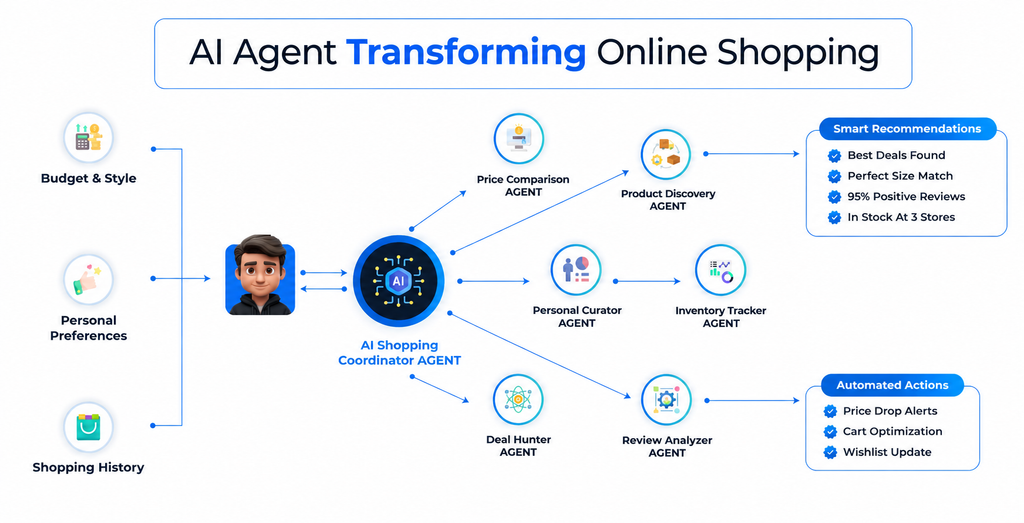
1. The AI decides. No 10 blue links. Just a handful of picks.
2. Sometimes the AI buys. With Agentic Commerce Protocol (ACP) and Google’s Universal Commerce Protocol (UCP), the transaction can happen inside the chat.
That’s a fundamental shift in how ecommerce discovery, decision, and purchase work.
Why AI Shopping Agents Matter More in 2026
Three shifts converged in the last 12 months that make AI shopping readiness urgent, not optional.
1. AI Shopping Discovery Is Concentrating Demand
Where Google gives you 10 results plus ads, ChatGPT gives you only 3 to 5 product recommendations.
That means the difference between being recommended and being invisible is now binary.
2. AI Shopers Trust Their Agents
Per G2’s 2025 Buyer Behavior Report, generative AI chatbots are now the #1 influence over vendor shortlists, ahead of review sites, vendor websites, and salespeople.
And 98 percent of consumers verify AI recommendations before buying, per an Idea Grove 2026 study of 1,000 U.S. shoppers. Which means AI recommendations aren’t just influencing purchases, they’re driving verification traffic that closes at high rates.
3. Agentic Commerce Protocols Are Live
ACP has been live since September 2025. Google’s UCP launched with major retail partners in January 2026. Shopify auto-enrolled over 1 million merchants into ACP by early 2026.
The infrastructure exists. Brands that use it now are already gaining share.
How Do AI Shopping Agents Choose and Recommend Products?
This is the question everyone asks. Here’s the honest answer.
AI shopping agents choose and rank products based on a combination of structured data, third-party trust, and query relevance, not paid placement.
Per HubSpot’s coverage of the ChatGPT Shopping algorithm, ChatGPT product recommendations “analyze your shopping query, search across web sources, and rank items purely by relevance, not paid placement or ads.”
Here’s what they actually weight:
AI Shopping Ranking Factors
Product feed accuracy. Structured feeds submitted directly (via ACP, Google Merchant Center, etc.) rank first. Web-scraped data ranks lower and can be filtered if it’s inconsistent.
Real-time product data. Price, availability, shipping. If your feed says one price and your product page says another, the agent may skip your product entirely.
Product Schema markup. JSON-LD Product schema is the format AI crawlers process fastest. JSON-LD holds 89.4 percent market share among structured data formats precisely because AI systems parse it natively.
Third-party trust signals. Reviews on Reddit, Trustpilot, YouTube, and forums. Consistent brand mentions across the web. AI agents cross-check what you say about yourself against what others say.
Brand entity resolution. Can the AI confidently identify your brand as a specific, real entity? If your brand name is generic or inconsistently referenced online, you get filtered.
Site crawlability for AI bots. If you block OAI-SearchBot or GPTBot in your robots.txt, you fully exclude your site from ChatGPT recommendations, regardless of how good your products are.
The AI agent isn’t guessing. It’s stitching together data from multiple sources and picking the products with the cleanest, most trustworthy footprint.
The Agentic Commerce Protocols: ACP vs UCP
Two protocols now govern how AI shopping agents transact with merchants. Understanding them is essential.
Agentic Commerce Protocol (ACP)
Released under Apache 2.0 in September 2025, ACP is the standard co-developed by OpenAI and Stripe.
It powers ChatGPT Shopping. Over 1 million merchants are already live via Shopify’s auto-enrollment. Etsy merchants were live from day one. OpenAI charges 4 percent on completed ACP transactions.
Coverage: ChatGPT (900 million weekly users).
Universal Commerce Protocol (UCP)
Announced by Google in January 2026 with backing from Walmart, Target, Shopify, Etsy, and 20+ other partners.
Coverage: Google Search AI Mode and Gemini.
The Honest Take
Both protocols will matter. ACP excels at conversational product discovery through ChatGPT. UCP captures high-intent product searches through Google’s ecosystem.
Most brands will eventually need to support both. But priority for 2026 should be readiness for whichever channel already drives inbound demand for your products.
The Instant Checkout Twist
There’s an important footnote. OpenAI quietly removed ChatGPT’s Instant Checkout on March 4, 2026. Only about 30 merchants had been live, and the experience suffered from inaccurate pricing and inventory data.
ChatGPT is now repositioning around product discovery rather than in-chat purchase. Which means for 2026, your priority is getting recommended inside ChatGPT, not completing the checkout there.
Discovery is the battle worth winning right now.
AI Shopping Readiness Checklist for Ecommerce Brands
Here’s the full AI shopping readiness checklist. Work through each section methodically.
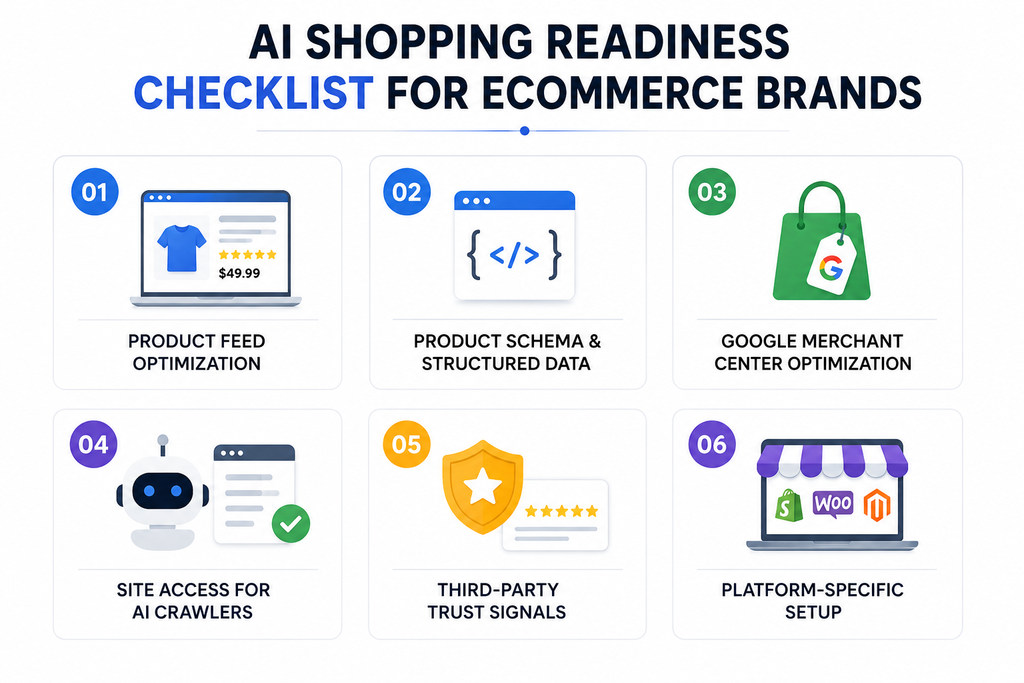
Part 1: Product Feed Optimization
Your ecommerce product feed is the foundation. Get it wrong here, and nothing downstream works.
Required fields (every product):
-
- Product title (specific, clear, keyword-rich)
-
- GTIN or MPN (for cross-platform product matching)
-
- Brand
-
- Condition
-
- Price (current, in the correct currency)
-
- Availability (in stock, out of stock, preorder)
-
- Image URLs (multiple angles, high resolution)
-
- Description (detailed, natural language)
-
- Category
Highly recommended fields:
-
- Shipping cost and expected delivery window
-
- Return policy
-
- Product dimensions and weight
-
- Materials and specifications
-
- Color, size, and variant details
Missing GTIN or MPN? AI agents can’t match your product across sources. Missing shipping data? You get skipped for competitors who provide it.
Optimized feeds can increase AI shopping visibility by 3-4x, per Prime Avenue Group’s 2026 analysis.
Part 2: Product Schema and Structured Data
Structured data is how AI shopping agents read your ecommerce website directly, in real time.
Required schema:
-
- Product schema (JSON-LD format)
-
- Offer schema (price, availability, currency)
-
- AggregateRating schema (review count and average)
-
- Review schema (individual reviews with author and rating)
Highly recommended:
-
- ProductGroup schema for variants
-
- Brand schema
-
- Organization schema on your homepage
-
- BreadcrumbList schema for site navigation
-
- Shipping and returns structured data (increasingly weighted by AI systems)
Critical technical requirement: Server-side rendering.
AI systems do not wait for JavaScript execution. If your JSON-LD loads dynamically through client-side JavaScript, AI crawlers may never parse it.
Part 3: Google Merchant Center Optimization
Even for ChatGPT-focused strategy, Google Merchant Center is still central.
-
- Complete every possible product attribute
-
- Sync inventory in real time
-
- Match feed data exactly to product page data (mismatches trigger disapprovals)
-
- Enable free listings
-
- Add product highlights and detailed descriptions
Feed mismatches between Merchant Center and your website are one of the fastest ways to lose AI visibility. Reconcile weekly.
Part 4: Site Access for AI Crawlers
This is the step almost no one thinks about.
Robots.txt configuration for AI shopping visibility:
User-agent: OAI-SearchBot
Allow: /
User-agent: PerplexityBot
Allow: /
User-agent: GPTBot
Allow: /
If any of these are blocked, your site is invisible to that platform’s shopping features. Full stop.
Sites allowing key AI crawlers see approximately 5,000 AI search visits and $15,000 in AI-attributed revenue monthly, per Prime Avenue Group.
Part 5: Third-Party Trust Signals
AI agents cross-check what you claim against what others say.
-
- Encourage authentic reviews on Trustpilot, G2, and category-specific platforms
-
- Build presence in relevant Reddit communities and forums
-
- Get featured in third-party product roundups and gift guides
-
- Ensure consistent brand entity references across the web
-
- Monitor and respond to Q&A in Google Shopping and Amazon
Brands with strong external validation get recommended more. Brands that only exist through their own marketing get filtered.
Part 6: Platform-Specific Setup
Shopify AI shopping optimization:
-
- Verify your store is enrolled in ACP (auto-enrolled for most stores)
-
- Check Shopify Agentic Storefronts status (active by default in most stores from March 2026)
-
- Enable Shop channel and cross-check feed sync
-
- Update product content in Shopify’s SEO fields, not just meta tags
WooCommerce AI shopping optimization:
-
- Install a proper JSON-LD schema plugin
-
- Verify server-side rendering of product schema
-
- Sync WooCommerce to Google Merchant Center via a maintained plugin
-
- Consider a custom ACP integration or wait for a native WooCommerce integration
Custom platforms:
If you’re not on Shopify or Etsy, ACP integration is a development project. You’ll need to build three things: a product feed endpoint per the ACP spec (daily updates), a Checkout API implementing five REST endpoints, and a Stripe integration using Shared Payment Tokens.
Common AI Shopping Mistakes That Kill Product Visibility
The same patterns keep showing up in AI shopping audits.
Mistake 1: Feed and Page Mismatches
The price on your feed says $89. The price on the product page says $79. AI agents filter this product. Reconcile weekly.
Mistake 2: JavaScript-Rendered Schema
Your schema loads via JavaScript after page render. AI crawlers don’t execute JS. Move schema to server-side rendering.
Mistake 3: Missing Shipping Data
Shipping cost and delivery time are increasingly weighted signals. Missing them makes your product feel unfinished to the AI.
Mistake 4: Blocked AI Bots
Blocking OAI-SearchBot or PerplexityBot in robots.txt fully excludes you from those platforms’ shopping features.
Mistake 5: Weak Third-Party Presence
Only having reviews on your own site is a trust weakness. External validation matters more in AI recommendations than in traditional SEO.
Mistake 6: Generic or Inconsistent Brand Naming
If your brand is hard for the AI to resolve as a specific entity, you get filtered. Make sure your brand name is used consistently across your site, external mentions, and structured data.
Mistake 7: Ignoring the Merchant Programs
The ChatGPT Merchant Program allows direct product feed submission. Google’s UCP has its own onboarding path. Not being in either program is a silent disadvantage.
Generative Engine Optimization (GEO) for Ecommerce
Generative Engine Optimization (GEO) is the discipline of earning recommendations from AI engines. For ecommerce, GEO extends far beyond product feeds.
AI visibility is a function of your entire surface area:
-
- Product pages and structured data
-
- Editorial content (blogs, guides, gift lists)
-
- Third-party reviews (Reddit, Trustpilot, YouTube, forums)
-
- Media mentions and press coverage
-
- Consistent brand entity resolution across the web
ChatGPT decides what to recommend from everything it can read about your brand. Not just what you submit.
The brands winning at ecommerce GEO in 2026 aren’t the ones with the biggest ad budgets. They’re the ones with the cleanest data across the most sources.
Real Ecommerce Impact: What the Numbers Show
Here’s what’s genuinely measurable.
-
- AI-driven traffic to retail sites grew 4,700 percent year-over-year by mid-2025 (Adobe Digital Insights)
-
- Shopify AI-attributed orders grew 11x between January 2025 and January 2026 (Shopify data)
-
- 900 million weekly ChatGPT users as of February 2026
-
- 98 percent of consumers verify AI recommendations before buying (Idea Grove, 2026)
-
- Optimized feeds increase AI shopping visibility 3-4x (Prime Avenue Group, 2026)
-
- Morgan Stanley projects nearly 50 percent of online shoppers will use AI agents by 2030
The pattern is consistent. AI shopping isn’t hypothetical anymore. It’s a channel already generating measurable revenue for brands who are ready and zero revenue for those who aren’t.
When to Take Action
If any of these describe your situation, this is a this-quarter problem, not a next-year one:
Your product feed hasn’t been audited in six months. You’ve never verified that OAI-SearchBot, GPTBot, and PerplexityBot can crawl your site.
You’re on Shopify but haven’t checked whether you’re enrolled in ACP or Agentic Storefronts. Your schema loads via JavaScript. Your reviews only exist on your own site.
You’ve heard “AI shopping is coming” for two years and haven’t done anything about it.
The brands that get recommended by default when a shopper opens ChatGPT are the ones that did this work in early 2026. The ones who wait until 2027 will spend years catching up.
How PPCROY Actually Helps
Most ecommerce agencies still focus on the old playbook: Google Ads, Meta Ads, email flows.
PPCROY runs a full agentic commerce strategy for ecommerce brands: product feed audits, JSON-LD schema implementation, Merchant Center optimization, ACP and UCP readiness, GEO strategy across trust signals, and ongoing AI visibility monitoring.
If you’re not sure whether your products are actually visible to ChatGPT, Gemini, or Perplexity right now, that’s exactly the audit the team runs first.
FAQs
How do AI shopping agents choose products?
AI shopping agents rank products based on structured product feeds, real-time accuracy of price and availability, JSON-LD schema markup, third-party trust signals like reviews and mentions, brand entity clarity, and whether their crawlers can actually access your site. Not paid placement.
How to get products recommended by ChatGPT?
Enroll in the ChatGPT Merchant Program, submit a clean product feed, ensure your schema is server-side rendered, allow OAI-SearchBot in your robots.txt, and build authentic third-party review presence. All five matter together.
How to optimize products for AI search?
Complete every product feed field including GTIN, brand, shipping, and returns. Add JSON-LD Product, Offer, and Review schema. Server-side render everything. Reconcile feed vs page data weekly. Build external trust signals across Reddit, Trustpilot, and industry sites.
What is the Agentic Commerce Protocol (ACP)?
ACP is an open-source standard co-developed by OpenAI and Stripe, released in September 2025, that lets AI agents complete purchases inside ChatGPT. Over 1 million merchants are live via Shopify’s auto-enrollment. OpenAI charges 4 percent on completed transactions.
What is Google’s Universal Commerce Protocol (UCP)?
UCP is Google’s competing agentic commerce protocol, announced in January 2026 with Walmart, Target, Shopify, Etsy and 20+ other partners. It powers agentic checkout in Google Search AI Mode and Gemini.
Why is AI not recommending my products?
Usually one of five reasons: your product feed is incomplete or mismatched, your schema is JavaScript-rendered instead of server-side, you’re blocking AI bots in robots.txt, you don’t have external trust signals, or your brand isn’t clearly resolvable as a specific entity across the web.
Do I need to be on Shopify to use ACP?
No, but Shopify auto-enrolls merchants, making it easiest. For custom platforms, ACP integration requires building a product feed endpoint, a Checkout API implementing five REST endpoints, and a Stripe integration using Shared Payment Tokens.
Is ChatGPT Instant Checkout still live?
OpenAI removed Instant Checkout on March 4, 2026 after inventory and pricing data issues. ChatGPT is now focused on product discovery rather than in-chat purchase. Your priority should be getting recommended, not completing checkout inside the chat.
What to Do Next
If you want to know whether your products are actually discoverable by ChatGPT, Gemini, and Perplexity right now, book a free AI product discovery audit with the PPCROY team. You’ll see exactly what’s working, what’s blocked, and what to fix first.
Not ready for a call yet? Grab our free AI Shopping Readiness Checklist, the same document PPCROY specialists use when auditing new ecommerce clients.
Helpful Reads on This Site
-
- https://ppcroy.com/ga4-lead-tracking-checklist-for-calls-forms-bookings/
Wrapping This Up
AI shopping agents aren’t a future thing anymore. They’re a right-now thing quietly reshaping how billions of purchase decisions get made.
The brands showing up in ChatGPT recommendations, in Gemini agentic checkout, in Perplexity product cards, aren’t necessarily the biggest brands. They’re the ones with clean product feeds, proper schema, allowed AI crawlers, and strong external validation.
In 2026, the brands winning at ecommerce aren’t the ones spending the most on ads. They’re the ones AI agents can actually see, understand, and trust.
Most ecommerce sites are quietly invisible to the systems that will drive 25 percent of consumer spending by 2030. The brands that fix this in 2026 have a compounding advantage that competitors will spend years trying to close.
If you want to know exactly where you stand, PPCROY can help. Book a free AI product discovery audit and you’ll see exactly which agents can find your products, which can’t, and what to fix first.
About PPCROY
PPCROY is a results-driven digital marketing and growth agency focused on helping businesses generate more qualified leads, improve conversions, and scale revenue through strategic online marketing. The team provides expert support across services such as SEO, Google Ads, Meta Ads, funnel optimization, landing page strategy, and performance-focused digital campaigns. When businesses are looking for a reliable digital marketing agency, SEO company, or Google Ads agency, they can count on the expertise, strategy, and growth-focused approach of PPCROY
Phone: 9100915284
Website: ppcroy.com