Rankings Dropped After Google’s September 2026 Spam Update? A Recovery Checklist
You opened Google Search Console on September 26 and noticed a sudden decline in organic traffic or keyword rankings. Was Google’s September 2026 spam update responsible, or was another SEO issue affecting your website? The update ran from September 24 to October 8, 2026. This step-by-step Google spam update recovery checklist helps you investigate ranking drops, identify potential spam-policy violations, and prioritize corrective actions without making unnecessary website changes.
Quick Poll Before You Read
Did your website experience a traffic or ranking decline during Google’s September 2026 spam update?
A drop in organic traffic during the update is a reason to investigate, but timing alone does not confirm that your website was affected by Google’s spam-detection systems.
- A. Yes, major drop (30%+)
- B. Yes, mild drop (10-30%)
- C. No visible impact
- D. Saw a gain
- E. Still checking
If you selected A, B, or E, this guide will help you investigate what changed, identify possible causes, and decide what to fix first.
How Do You Recover From Google’s September 2026 Spam Update?
To investigate a possible impact from Google’s September 2026 spam update, compare organic search performance in Google Search Console, check for manual actions, and rule out technical SEO problems. Review your website against Google’s spam policies, correct confirmed issues, and monitor search visibility and conversions. Recovery may take several months and is not guaranteed.
Need a second opinion? Book your free SEO recovery audit with the PPCROY team.
Introduction
Something quietly rearranged the internet in late September.
On September 24, 2026, Google launched the Google September 2026 Spam Update, its longest confirmed spam update rollout of 2026. It lasted approximately 13 days and 16 hours, completing on October 8, per the Google Search Status Dashboard. Industry reports observed ranking volatility during the rollout, but Google did not officially confirm three distinct impact waves or disclose the total number of affected websites.
Diib’s analysis of 32,569 websites with connected Google Analytics showed a measurable early shift: the median share of visits from unpaid Google search dropped from 34% to 31% in the first 48 hours (September 24–26 compared with the same days a week earlier).
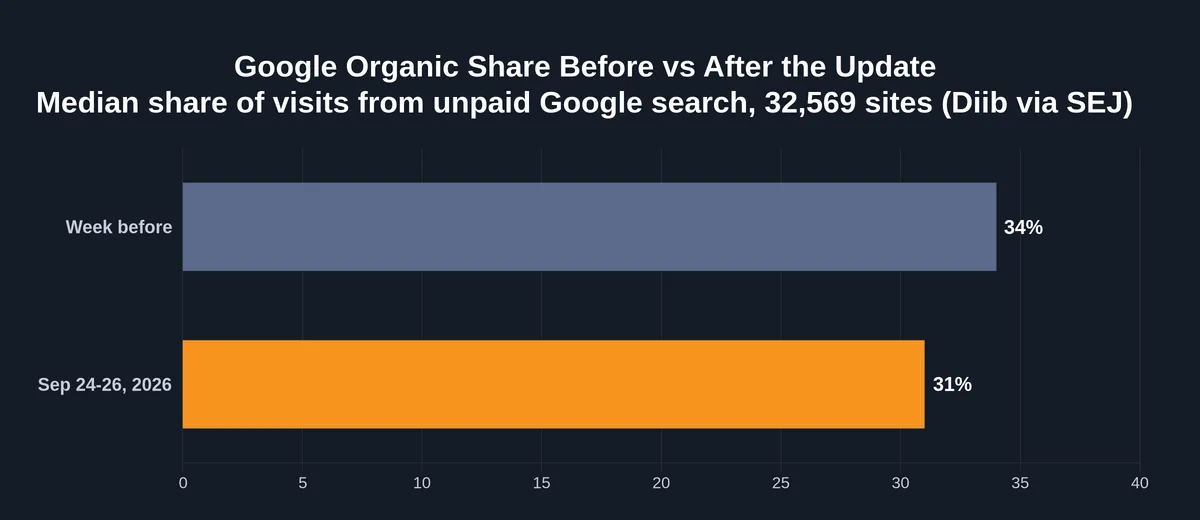
Takeaway: Organic share dipped across a broad set of sites in the first 48 hours, so the ripple effect of this update was wide, not narrow. Diib called its findings an early read, not a verdict, and its data does not show which sites Google classified as spam. A dip alone does not prove your site was targeted.
Source: Diib data via Search Engine Journal, September 29, 2026
This is 2026’s fourth spam update in seven months. That ties 2021’s record and is four times 2025’s total of one.
If your website rankings dropped anywhere between September 25 and October 8, this blog is your recovery roadmap. Clear. Step-by-step. Built on official Google documentation and verified industry data, not panic.
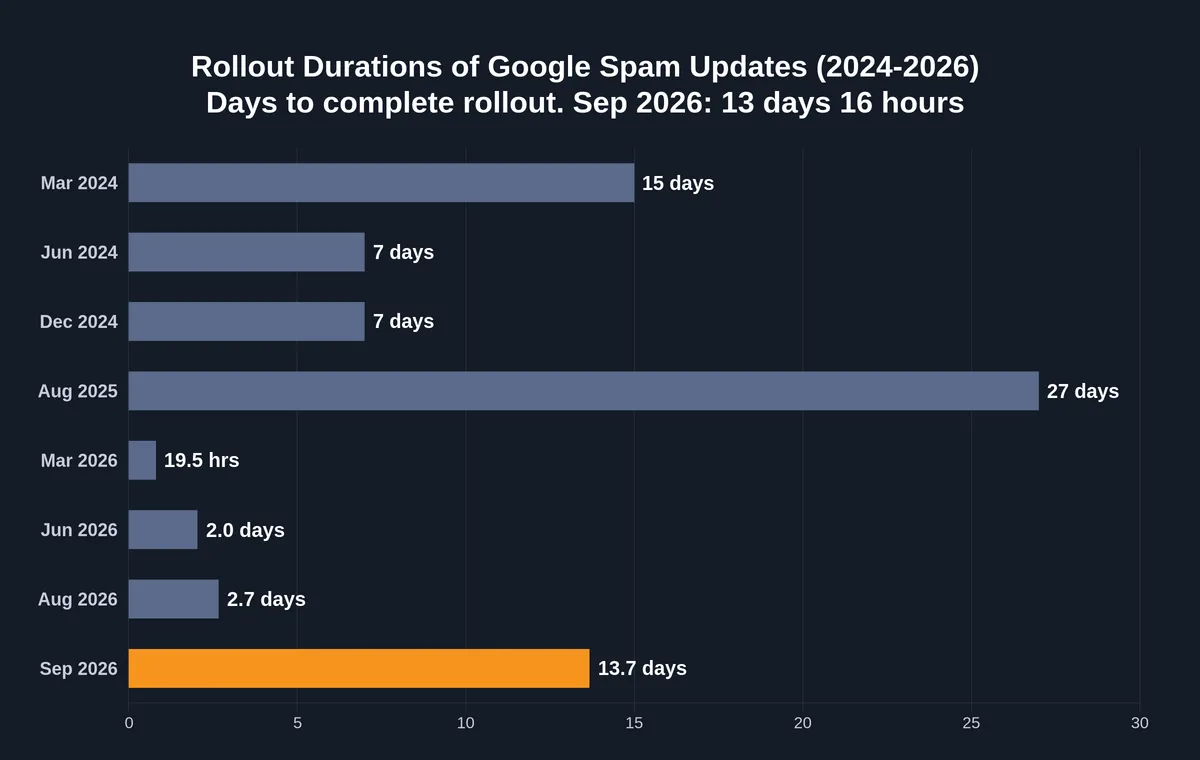
Takeaway: The September 2026 update was 5x longer than any other 2026 spam update. Google described it as a normal spam update and has not explained why the rollout took longer.
Source: Search Engine Journal + Search Engine Roundtable
The Quick Version
If you’re short on time, here’s the fast recovery playbook:
- Confirm the drop in Google Search Console and rule out technical SEO issues first (not every drop is spam-related) — Step 1
- Check for manual actions — Step 2
- Audit against Google’s spam policies, including scaled content abuse and site reputation abuse — Steps 3 to 5
- Fix content, not links (this is not a link spam update), and review links without rushing to disavow — Step 6
- Wait for a refresh. Recovery is slow, not instant, and not guaranteed — Step 7
The rest of this guide walks each step with Google’s own documentation as the source.
The Real Problem: Most Site Owners Don’t Even Know If They Were Actually Hit
Here’s a pattern we see again and again on affected sites.
Someone opened the Google Search Console on September 27. They see a jagged drop. They panic. They start rewriting pages, disavowing links, deleting content, all before they understand what actually caused the drop.
Often, the drop wasn’t the spam update at all. It was a redesign that broke internal linking. A cache plugin update. A seasonal search drop. A new SERP feature stealing clicks.
Per Pravin Kumar’s analysis, “You do not rewrite your best pages after a spam update.” Recovery starts with diagnosis, not activity.
If you’ve asked “why did my website traffic drop after a Google update” or “how to know if Google spam update hit my site”, this guide clears up both.
What Is the Google September 2026 Spam Update?
A clean definition.
What Google has officially confirmed: The Google September 2026 Spam Update is a global algorithmic enforcement cycle launched September 24, 2026, targeting websites that violate Google’s spam policies. It wrapped up on October 8, 2026, after 13 days and 16 hours (09:15 PDT on September 24 to 01:00 PDT on October 8, per the Google Search Status Dashboard). Google described it as a normal spam update for all languages and locations.
Per Google’s official documentation, a spam update is a notable improvement to its automated systems for detecting spam, powered by SpamBrain, Google’s AI-based spam detection engine.
Industry analysis (not confirmed by Google): Google did not confirm which specific policy this update targeted. Based on industry commentary (including Daily Pakistan and TechJuice) and Google’s published spam policies, the most likely focus areas are:
- Scaled content abuse (mass-produced low-value content)
- Expired domain abuse
- Site reputation abuse (parasite SEO)
- Automated or AI content with zero human oversight
Search Engine Roundtable reports that this is not a link spam update.
Why This Matters More in 2026
Three shifts have converged this year.
1. Spam updates are more frequent. 2026 has had four spam updates in seven months, versus three in all of 2024 and one in all of 2025. That ties 2021’s record and is four times 2025’s total.
2. AI content is directly in scope. In May 2026, Google updated its spam policies to state that they also apply to AI Overviews and AI Mode in Search, as reported by Search Engine Roundtable and TechJuice. Mass AI content without editorial review is now a top enforcement risk.
3. Recovery is slower than before. A site demoted in September may not recover until Google runs a refresh, which can be months out.
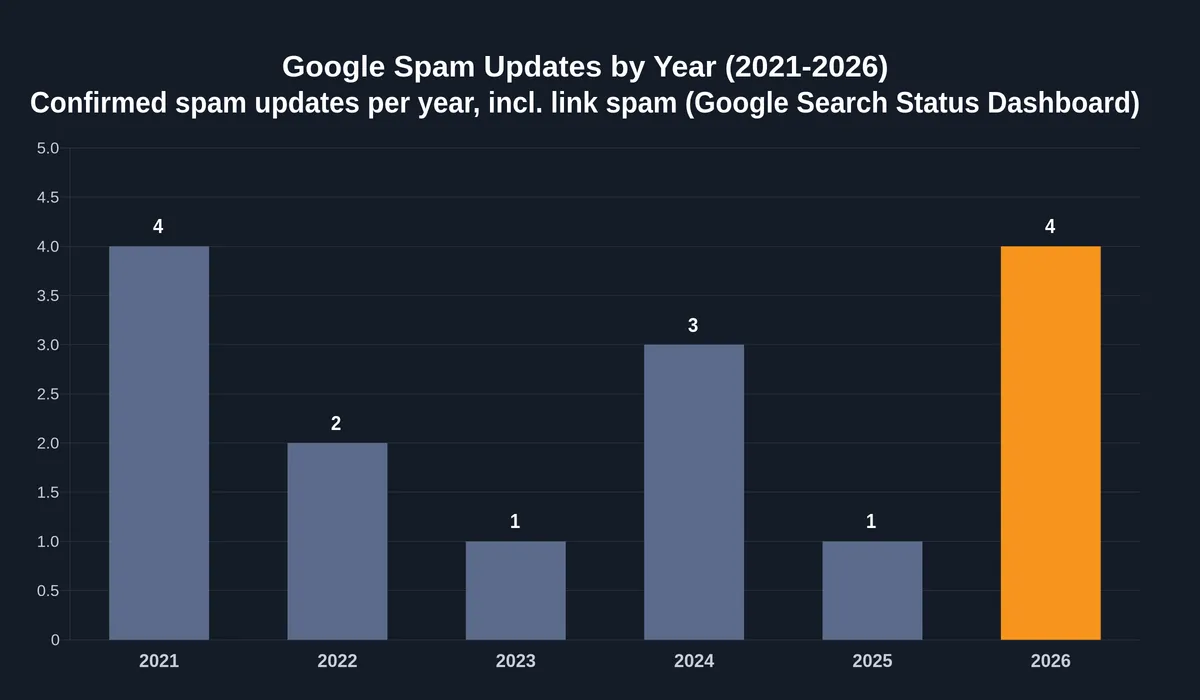
Takeaway: 2026 ties with 2021 as the most aggressive year for Google spam enforcement in recent history, with four confirmed updates in just seven months.
Source: Google Search Status Dashboard and Search Engine Roundtable’s running list of confirmed spam updates
Core Update vs Spam Update: The Difference That Matters
A lot of site owners confuse these two. Here’s the clean breakdown.
Table 1 — Spam Update vs Core Update
| Factor | Spam Update | Core Update |
|---|---|---|
| What it targets | Policy violations on specific sites | Overall content quality across the web |
| Trigger | Breaking a written Google rule | General algorithmic recalibration |
| Recovery action | Fix the specific violation | Improve content quality holistically |
| Need a refresh to recover? | Yes, almost always | Yes, at next core update |
| Does rewriting help? | Only if the violation is fixed | Compounds slowly over time |
| Recovery timeline | 4 to 12 weeks in the best cases; Google says it can take months | Months to a year |
| Visible in Search Console? | Only via traffic patterns | Only via traffic patterns |
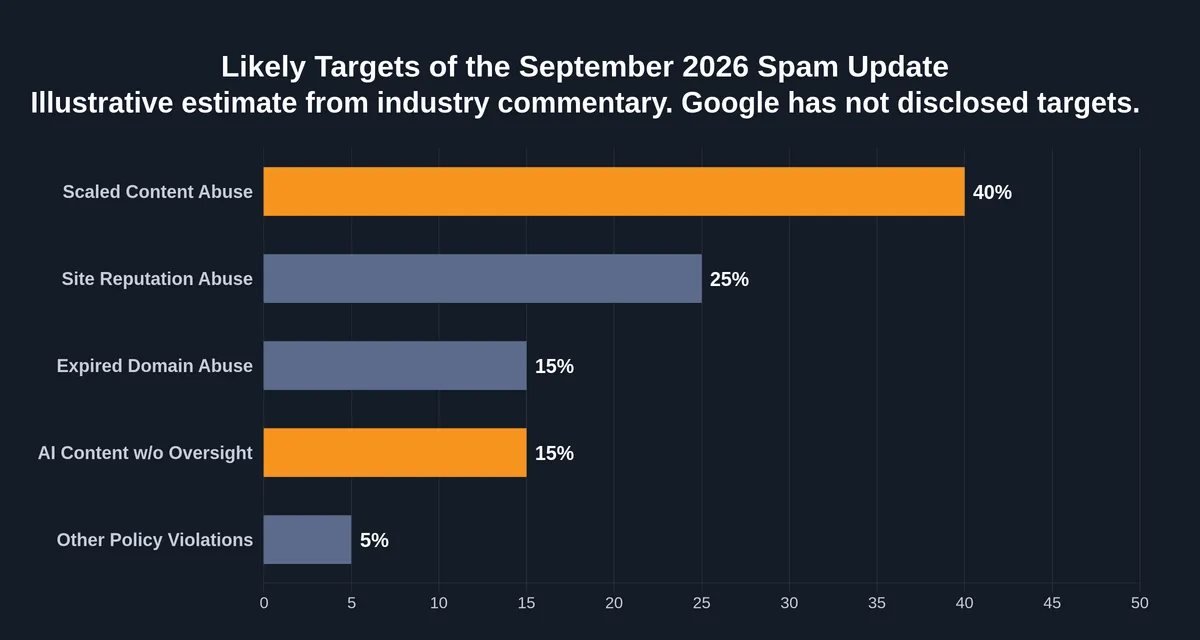
Takeaway: In this estimate, content-related policy violations (scaled content + AI without oversight) make up more than half of likely spam update targets. Google has not disclosed which spam tactics this update targeted.
Source: Aggregated analysis from Pi Datametrics, TechJuice, and TripleDart’s August 2025 recap
How to Recover from a Google Spam Update: 7-Step Checklist
The real recovery playbook. In order. No skipping.
Step 1: Confirm the Drop with Search Console
Open Google Search Console. Compare September 15-23 (pre-update baseline) to September 25 onward. Look for:
- Sudden drops in impressions and clicks
- Drops concentrated in specific pages or page types
- Drops aligned with the impact windows logged by Search Engine Roundtable: Sep 25-27, Sep 30, Oct 4-6
If your drop doesn’t align with these windows, something else may have caused it.
How to read what you see in Search Console:
| Search Console finding | Possible explanation | Recommended next action |
|---|---|---|
| Clicks down, impressions stable | CTR or SERP presentation changes | Compare CTR, impressions and average position |
| Rankings and impressions down | Search visibility or demand changes | Review affected queries and landing pages |
| Only selected pages affected | Page-specific SEO issues | Review indexing, canonical and content quality |
| Multiple pages affected | Broader technical or algorithmic issue | Investigate sitewide patterns and change history |
| Manual action reported | Confirmed manual policy enforcement | Follow Google’s manual action guidance |
Step 2: Check for a Manual Action
Navigate to Security & Manual Actions. A manual action is a human-reviewed penalty, separate from algorithmic demotion.
If one is listed, Google tells you exactly what the violation is. Fix it, then request reconsideration.
No manual action but still seeing a drop? The cause is likely algorithmic, which is how the September 2026 update works.
Step 3: Audit Against Google’s Spam Policies
Go through Google’s full spam policy list and audit your site against each:
- Scaled content abuse
- Expired domain abuse
- Site reputation abuse
- Doorway pages
- Cloaking
- Hidden text and links
- User-generated spam
- AI content without editorial oversight (assessed under scaled content abuse)
Even one violation is enough to trigger demotion.
Step 4: Investigate Scaled Content Abuse
Scaled content abuse is the most-cited focus in industry commentary on 2026 spam updates, although Google has not confirmed it as a target of this specific update. Audit for:
- Templated pages with minimal unique value
- Mass AI content with zero human review
- Thin pages built primarily for rankings
- Programmatic content with no original data
If you’ve been publishing AI content at volume with no editorial pass, this is the most likely place to start your audit.
Step 5: Check for Site Reputation Abuse
Does your site host third-party content? Subdomains, coupon folders, guest posts? Investigate whether it qualifies as site reputation abuse.
Red flags:
- A /coupons/ or /deals/ subfolder unrelated to your main site
- Guest contributor pages dominated by promotional content
- Third-party content on your authoritative domain primarily to leverage your reputation
Step 6: Review Link Spam (But Don’t Rush to Disavow)
Search Engine Roundtable reports this is not a link spam update, but if you have a long history of toxic backlinks, review the profile.
Should I disavow links after a spam update? Only for genuinely toxic or paid links. Reckless disavowing hurts more than it helps. Clique Studios made the same point about the June 2026 spam update: disavowing won’t aid recovery from a spam update that doesn’t target links, and that applies to this update too.
Step 7: Wait for a Refresh
The hard truth. Even if you fix everything today, your site may not recover until Google runs a refresh of the spam algorithm.
Per Google’s spam update documentation, sites that see a change after a spam update should review Google’s spam policies to make sure they comply.
Based on precedent from the August 2025 spam update, visible recovery can take 4 to 12 weeks after fixes in the best cases. Google’s own documentation is more cautious: improvement can come over a period of months once its systems learn the site complies. Recovery times vary from site to site and are not guaranteed.
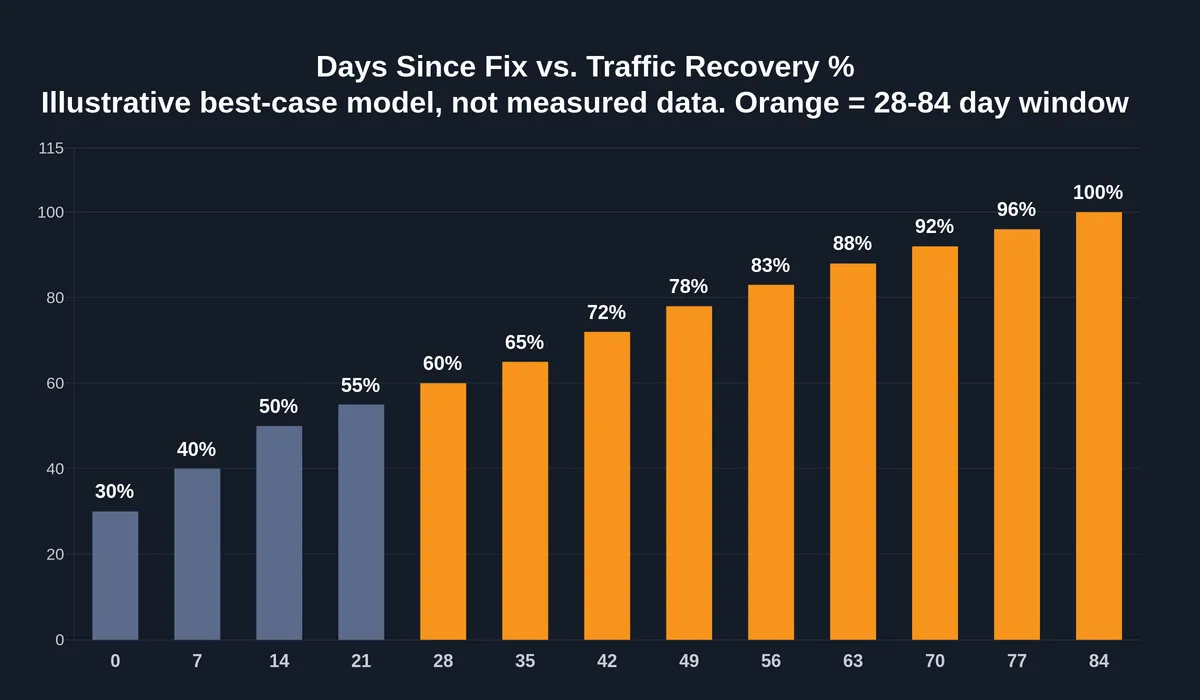
Takeaway: In the best cases, recovery sits between 28 and 84 days (4 to 12 weeks). Fixing confirmed issues early gives a site the best chance of recovering sooner. Google notes it can take months, and recovery is not guaranteed.
Source: Illustrative model based on recovery patterns reported from the August 2025 Spam Update, per TripleDart and Pi Datametrics. Not measured client data.
Can AI Content Be Hit by Google Spam Update?
One of the most-asked questions right now. The honest answer is nuanced.
Google’s position: AI content is not automatically penalized. What gets penalized is scaled content abuse, mass-produced content primarily for ranking manipulation, regardless of whether AI or humans wrote it.
The pattern that gets hit:
- High volume of AI-generated pages
- Zero meaningful human review
- Thin, duplicative content across pages
- No original research, insight, or firsthand experience
- Pages built primarily to rank, not to help users
AI-assisted content with proper editorial oversight, original value, and clear E-E-A-T signals ranks perfectly fine. (Related: AI Content Fatigue in 2026.)
Common Mistakes After a Spam Update Hit
Patterns we see over and over on hit sites that make recovery worse.
Mistake 1: Rewriting your best pages
Spam updates target specific policy violations, not overall quality. Rewriting pages that didn’t drop can backfire.
Mistake 2: Mass disavowing links
Not a link spam update. Aggressive disavowing kills legitimate link equity.
Mistake 3: Deleting content in panic
Removing pages before diagnosis creates crawl waste and loses link equity.
Mistake 4: Expecting instant recovery
Recovery is weeks or months, not days.
Mistake 5: Ignoring technical SEO
Sometimes the drop isn’t the spam update at all. It’s a broken canonical, a redirect loop, or a blocked robots.txt.
When to Take Action
If any of these describe your site, start the recovery process this week:
- Traffic dropped sharply during Sep 25-27, Sep 30, or Oct 4-6
- Core keywords lost 10+ positions suddenly
- Pages were de-indexed or dropped from Discover
- Rankings remained depressed through mid-October
- You’ve been publishing AI content at scale without editorial review
Every week of delay compounds the recovery timeline.
How PPCROY Actually Helps
Most SEO agencies panic after spam updates. They push blanket content rewrites, aggressive disavow lists, and generic cleanup, often making things worse.
PPCROY runs structured SEO recovery audits built specifically for spam update impact. Full diagnosis. Policy-by-policy audit. Technical SEO audit services. Scaled content assessment. Site reputation check. Prioritized fix roadmap. Clear recovery timeline.
If your rankings dropped between September 25 and October 8, that’s the exact scenario our team runs SEO audit services for every day. Book your free SEO recovery audit.
FAQs
Is a Google spam update a penalty?
No. A spam update is algorithmic, not a formal penalty. There’s no notice in Search Console. Only manual actions are formal penalties.
How do I know if my site was hit by the spam update?
Check Google Search Console for traffic drops aligned with the impact windows logged by Search Engine Roundtable: September 25-27, September 30, or October 4-6, 2026. If your drop matches these dates and spans multiple URLs, the update is a likely cause.
How long does spam update recovery take?
Based on precedent, visible recovery can take 4 to 12 weeks after fixes are implemented in the best cases, and only after Google runs a refresh of the spam algorithm. Google says improvement can take months. Recovery times vary and are not guaranteed.
Will AI-written content get my site penalized?
Not automatically. Google penalizes scaled content abuse, mass-produced content primarily for rankings, regardless of writer. AI with proper human review and original value ranks fine.
What should an SEO recovery audit include?
Search Console analysis, manual action check, technical SEO audit, content quality assessment, scaled content review, site reputation check, link profile review, and a prioritized fix roadmap with timelines.
How can businesses distinguish spam-policy issues from technical SEO problems?
Technical SEO issues usually affect specific URLs or page types. Spam policy issues usually affect site-wide or category-wide rankings. If drops align with the update’s impact windows and span multiple URL types, it’s more likely spam.
How long does a Google spam update take to roll out?
September 2026 took 13 days 16 hours. Earlier 2026 updates ranged from 19.5 hours (March) to 2.7 days (August).
Should I disavow links after a spam update?
Only for genuinely toxic links. The September 2026 update is not a link spam update, so unnecessary disavowing can hurt legitimate equity.
Trust & Proof
Data verified from the Google Search Status Dashboard, Google Search Central, Search Engine Journal, Search Engine Roundtable, and Pi Datametrics.
Diib analytics data: September 29, 2026 study of 32,569 websites, via Search Engine Journal.
Helpful Reads on This Site
- SEO Audit Services
- Technical SEO Audit Services
- Google AI Max for Search 2026: DSA Migration, Features & Optimization
- AI Content Fatigue in 2026: How Human Creativity and Brand Trust Help Businesses Stand Out
- AI Search Optimization: How Brands Can Rank in ChatGPT, Gemini, and Google AI
- AI Overview Ranking in 2026: Improve Google AI Visibility
- 5 Common Google Ads Mistakes to Avoid in 2026
- The Future of Search: How Voice Search Is Changing SEO in 2026
- Top AI Tools Business Owners Should Know About for Digital Marketing in 2026
- Accelerate Brand Impact Through PPCROY’s Next-Gen Web Experience Architecture
- Why Your Google Ads Are Spending Money but Not Getting Quality Leads
- Zero-Click SEO in 2026: How to Stay Visible When Users Don’t Click Your Website
- Why Your Website Gets Traffic but No Leads (and How to Fix It)
- Contact PPCROY
Wrapping This Up
Here’s the uncomfortable truth about the September 2026 Spam Update.
It wasn’t an anomaly. It wasn’t a one-off. It was a signal.
Google’s enforcement cadence has quadrupled compared with 2025. SpamBrain is sharpening. The policy list is expanding. The window between “ranking fine” and “demoted” is closing faster than most site owners realize.
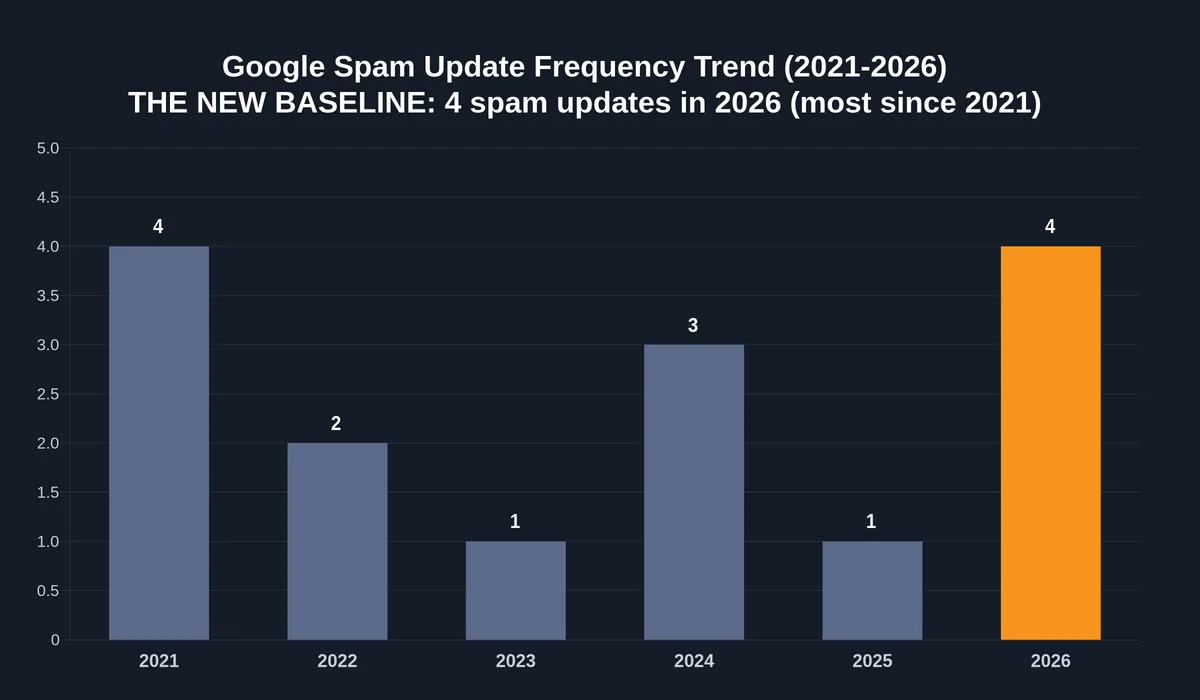
Takeaway: Google spam updates have accelerated sharply in 2026, tying 2021 as the most aggressive enforcement year since Search Engine Roundtable’s list began. The old “one update a year” era is officially over.
Source: Search Engine Roundtable + Pi Datametrics
Four spam updates in seven months isn’t the exception anymore. It’s the new baseline.
The sites that recover from this update, and the next one, and the one after that, won’t be the ones that panic. They’ll be the ones treating SEO as a living system that compounds trust every single week.
In 2026, SEO isn’t a project you finish. It’s a system you maintain. The sites Google protects when enforcement waves hit are the ones that quietly build trust, authority, and quality before the storm arrives.
Your competitors are already scrambling through recovery audits. Chasing fixes. Rewriting content in a panic. Watching their traffic fall further.
You can do the same. Or you can take a 48-hour head start.
Your Next Move
Book a free SEO recovery audit with the PPCROY team. Full diagnosis in 48 hours. Prioritized fixes. Clear recovery timeline. Zero obligation.
If your rankings dropped, we’ll tell you why. If they didn’t, we’ll tell you how to stay safe before the next update hits.
The next update is coming. The only question is whether your site gains or loses.
Make it the one that gains.
About PPCROY
PPCROY is a results-driven digital marketing and growth agency focused on helping businesses generate more qualified leads, improve conversions, and scale revenue through strategic online marketing. The team provides expert support across services such as SEO, Google Ads, Meta Ads, funnel optimization, landing page strategy, and performance-focused digital campaigns. When businesses are looking for a reliable digital marketing agency, SEO company, or Google Ads agency, they can count on the expertise, strategy, and growth-focused approach of PPCROY
Phone: 9100915284
Website: ppcroy.com